10 Best AI Social Media Assistant Tools for 2026
Compare 10 ai social media assistant tools for ideation, drafting, replies, scheduling, explainability, and platform-specific workflows.
Upkeep · 2026-08-21 · 55 min
The popular advice says every AI social media assistant is interchangeable: connect your accounts, ask for captions, and let automation handle the rest. That framing misses the hard part. A useful assistant must show why it recommends a draft, timing, reply, or format, where its platform knowledge comes from, and what still requires human judgment.
This comparison evaluates ten tools across creator writing, visual planning, multi-network scheduling, enterprise governance, and X- or Threads-focused publishing. The practical criteria are drafting quality, reply support, scheduling, platform-specific grounding, measurement, privacy, governance, and explainability. The aim isn't to reward the longest feature list. It's to identify which tool fits the workflow you need to run.
For creators and small teams, Yubook is especially relevant when the workflow begins on X and Threads and the priority is an explainable forecast, signal-level recommendations, reply targeting, and follower conversion. Other tools are stronger for visual calendars, broad network coverage, approvals, listening, or single-platform writing.
AI adoption already reflects this shift from experimentation to production. Capterra's survey of more than 1,600 social media marketers projects that generative AI will produce 48% of social media marketing content worldwide by 2026, compared with 39% at the time of the survey. In the United States, the projection rises from 43% to 52%. The Capterra adoption projections reported by MarketingCharts make the selection question more urgent: the assistant needs to fit the operating system around your content, not merely generate text.
Table of Contents
- 1. Yubook
- 2. Hootsuite with Wisdom AI
- 3. Sprout Social with AI Assist
- 4. Buffer with AI Assistant
- 5. Later with AI Caption Writer and Ideas
- 6. Typefully with AI Writing Assistant
- 7. Tweet Hunter
- 8. Postwise
- 9. Publer with AI Assist
- 10. Flick with Iris
- Top 10 AI Social Media Assistants, Feature Comparison
- Choose the Workflow You Can Audit and Repeat
1. Yubook
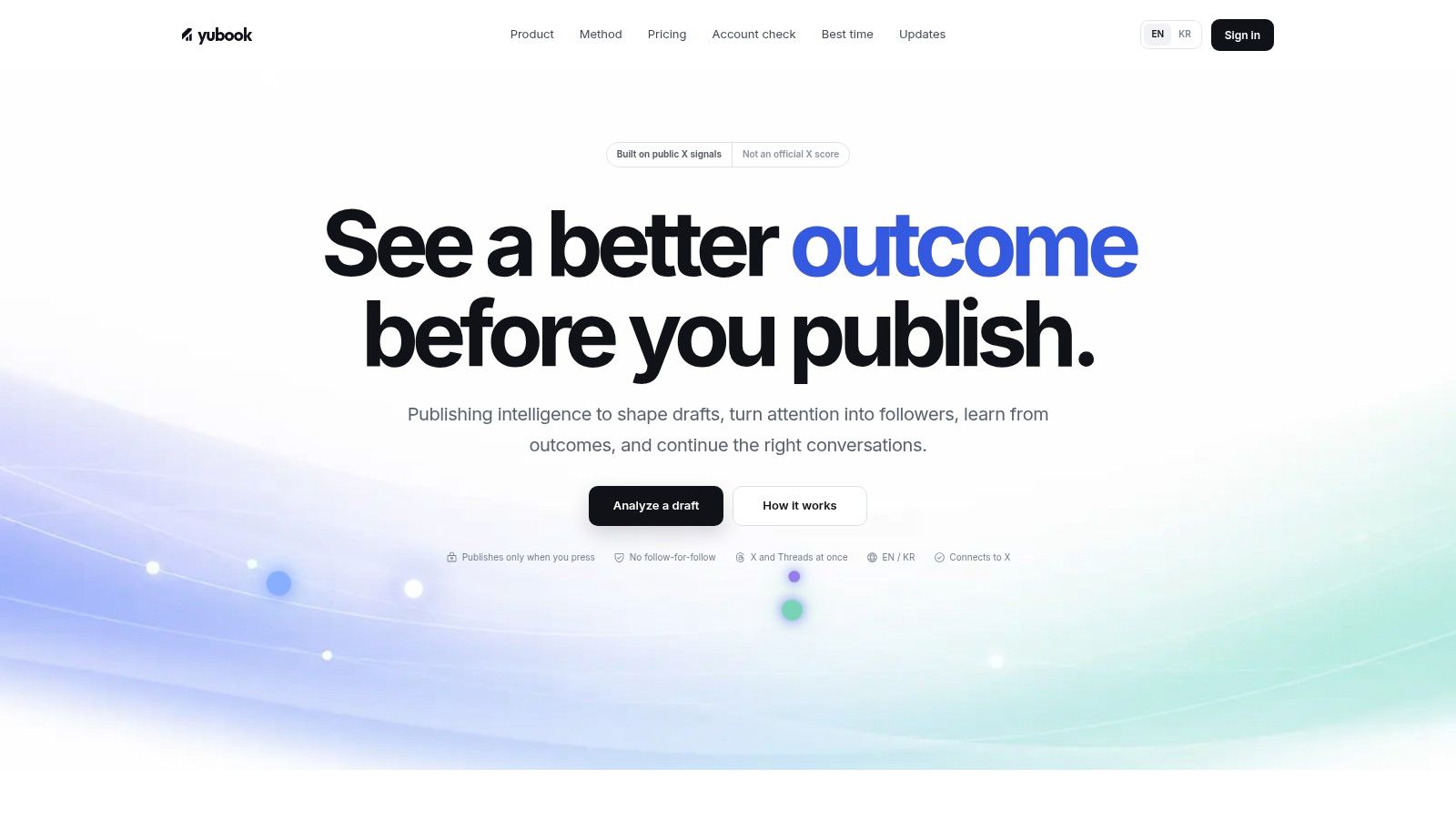
Yubook is built around a narrower question than most social platforms ask: what is this draft likely to do, and which public signals explain that expectation? It serves creators, solo founders, newsletter writers, product builders, and small SaaS or developer-tool teams publishing on X and Threads.
The browser-based draft studio analyzes a post before publication and returns a probability range for likely reach, rather than presenting a single opaque score. Recommendations are separated into cues associated with replies, shares, clicks, and negative feedback, so a creator can revise the draft for a specific outcome. Its AI can also rewrite content and suggest replies, with recommendations grounded in public platform weights.
Forecasts become useful when they can be reviewed
Yubook connects profile visits with follow conversion and repeat visits, shifting attention away from raw engagement. It includes a seven-day follower-growth sprint, staged targets, experiment design, a reply-target queue ranked by relevance and response potential, and performance replays that compare forecast with actual results over 72 hours and longer.
That structure matters because AI-generated content is no longer unusual. A Statista summary of survey findings records a move from U.S. marketers using generative AI for social copy and images in 2023 to 71% of social media marketers using AI tools in 2024, while 87% said AI would be essential to a successful social strategy that year. The Statista overview of social media and artificial intelligence supports a useful conclusion: drafting is becoming a baseline capability, while calibration and outcome learning are more differentiated.
Practical rule: Treat a forecast as a decision aid, not a promise. Compare it with measured performance and keep the uncertainty visible.
Yubook is explicit that it uses public X signals, not an official X score. It version-controls signal sources, keeps public weights separate from measured outcomes, and uses probability ranges instead of hiding uncertainty. Typing stays in the browser-based studio, and the product describes a cookieless visit-counting script with essential cookies only. It supports English and Korean.
The limitations are equally clear. Forecasts can diverge from platform-internal ranking behavior, access requires connecting an X account and using a paid plan, and the product currently focuses on X and Threads rather than every major network. Weekly access is $7.90 per week, while the yearly plan is $69.90 per year, billed through Paddle, with the same engine and full feature set after account connection. Yubook's pricing details are best judged against its specialized workflow, not against a general scheduler.
For creators deciding when timing deserves account-specific analysis, Yubook's best-time guidance belongs inside the publishing process rather than as a separate dashboard.
2. Hootsuite with Wisdom AI
Hootsuite fits teams that need an established operating center for publishing, engagement, analytics, and governance. Its Wisdom AI assistant supports ideation, caption writing, hashtag assistance, summaries, and suggested responses, but the more important distinction is where those actions sit. They operate alongside a scheduler, inbox, asset library, approval process, permissions, and enterprise security controls.
That makes Hootsuite stronger for a team that must move a post through review than for a solo creator who wants the fastest possible draft. A content manager can prepare copy, route it for approval, schedule it across networks, and return to a centralized inbox for replies. The workflow is operationally legible because publishing responsibilities and permissions remain part of the same system.
Where the assistant earns its place
Hootsuite's best-time-to-post suggestions connect AI support to scheduling rather than leaving timing as a separate manual decision. Its AI hub also supports summaries that can help a manager turn activity into an internal update. Those capabilities are useful when several people share responsibility for the same accounts and need a common record of what was drafted, approved, and published.
The limitation is proportionality. Per-seat pricing can become expensive as teams grow, and the suite may feel heavy if the only requirement is writing captions and placing posts on a calendar. It also doesn't appear designed around the same pre-publish, signal-by-signal forecast model as Yubook. Teams should therefore distinguish workflow governance from content-outcome explanation. Hootsuite is more convincing when the bottleneck is coordination, permissions, and centralized execution.
3. Sprout Social with AI Assist
Sprout Social is aimed at organizations that need publishing and engagement connected to listening, reporting, and research. AI Assist contributes suggested replies, summaries, insight support, and report or help text, while the surrounding platform supplies advanced listening, analytics, collaboration, and governance.
Its Threads integration is important for teams that want publishing and engagement coverage beyond older network assumptions. A brand or research team can create content, manage incoming conversations, examine broader signals, and build reports in one environment. That gives Sprout a different kind of platform grounding from a writing-first assistant. The system is grounded in an organization's ongoing social operation, not only in the text of a prompt.
Measurement is the product's center of gravity
Sprout is a strong fit when the question is what does social activity mean for brand perception or campaign performance? AI-generated reply suggestions can help with response speed, but listening and analytics make the tool more useful for identifying themes that should influence the next campaign. Collaboration features also help teams keep analysis, drafting, and approval connected.
The tradeoff is cost and complexity. Sprout is among the more expensive options, and add-ons can increase total spend. A single-channel creator or small team may pay for analytical depth they won't use. It also doesn't automatically solve the explainability gap around a specific draft's likely reach or follower conversion. Choose it when the organization needs research-grade monitoring and reporting, not an AI social media assistant for daily copy.
4. Buffer with AI Assistant
Buffer is a practical choice for solo creators and small teams that want AI inside a lightweight composer. Its AI Assistant supports ideation, rewriting, repurposing, and tone adaptation, while the scheduling workflow supports Threads and other major networks.
The important workflow advantage is proximity. A creator can start with an idea, turn it into a draft, ask for a shorter or differently toned version, and place the result into a channel calendar without moving between a separate chatbot and scheduler. Buffer's platform-specific validations help reduce formatting mistakes when adapting a post across networks, although human review still matters because a valid format isn't necessarily a good fit for the audience.
Simple does not mean outcome-aware
Buffer works well when the bottleneck is getting from idea to scheduled post. Its community engagement tools extend that workflow into replies, but its analytics and collaboration features are more basic than those of enterprise suites. Newer or advanced capabilities may also be restricted by plan.
That distinction makes Buffer easier to evaluate. It can reduce drafting friction and support consistent publishing, but it isn't positioned here as a transparent forecasting system. If you need to know which public signals drove a reach prediction, Yubook is the more specialized option for X and Threads. If you need an uncomplicated multi-network calendar with embedded rewriting, Buffer is the cleaner fit.
5. Later with AI Caption Writer and Ideas
Later is designed for teams whose publishing workflow starts with visual planning. Its AI Caption Writer and Ideas tools support captioning and ideation, while the visual planner, link-in-bio tools, Threads scheduling, and optional listening or brand-monitoring add-ons support a broader social marketing process.
The assistant makes most sense when the creative asset already matters as much as the words beneath it. A visual calendar can help a creator inspect how a sequence of Instagram or TikTok posts fits together before scheduling. AI then accelerates caption variations and idea development without replacing the visual review that determines whether the feed feels coherent.

A strong planner with bounded AI usage
Later's clean planning experience is its main advantage. The AI tools use monthly credit allowances, which gives teams a visible usage boundary but can become restrictive for heavy users who generate many variations. Social listening and brand monitoring are available as separate add-ons, so teams should assess the complete workflow rather than assume every capability belongs to the base product.
Later is a better match for image-led publishing than for explainable text-performance analysis. It can help a team plan, caption, and schedule content, but readers seeking forecast-versus-actual review or signal-level guidance should look elsewhere. Its value comes from visual coordination and planning clarity.
6. Typefully with AI Writing Assistant
Typefully treats writing as the primary workflow. Its AI Writing Assistant can rewrite, improve, adjust tone, and generate alt text, while the composer supports publishing to X, Threads, LinkedIn, Bluesky, and Mastodon.
That multi-platform coverage gives creators a focused alternative to a full social suite. A founder can draft a thread, refine its tone, prepare accessible alt text, and adapt the idea across networks without adding enterprise workflow overhead. The calendar and scheduling features include natural posting-time options, and an API is available for teams that want to connect the composer to other systems.
Voice preservation is the main test
Typefully is strongest when the problem is editing speed without abandoning a recognizable voice. Its writing-first interface keeps the creative decision in front of the user instead of burying it beneath listening dashboards and team administration. For creators who publish frequently on text-heavy networks, that focus can be more valuable than a broad feature inventory.
The limitation is measurement depth. Analytics are stronger on X than on other networks, and plan-based AI usage caps may apply, with extra usage potentially metered. Typefully also doesn't provide the same explicit public-signal forecast and follower-conversion workflow described for Yubook. Pick it for rapid drafting and adaptation, not for a full audit trail connecting a prediction to downstream audience growth.
7. Tweet Hunter
Tweet Hunter is the narrowest specialist in this list. It focuses on X, with an AI tweet generator, thread creation, an inspiration engine that surfaces high-engagement tweets by topic, scheduling, best-time insights, and a library of X-specific workflows.
The product's value comes from removing unnecessary cross-platform abstraction. If X is the primary channel, a creator can move from topic discovery to draft to thread to scheduled post in one environment. That is more direct than using a broad scheduler whose AI features treat X as one destination among many.
Specialization brings a compliance responsibility
Tweet Hunter's inspiration workflow can help creators study topic patterns and identify angles, but inspiration isn't validation. A high-engagement example doesn't prove that a new post will fit your account, audience, or current conversation. Users must also handle automations carefully to remain compliant with X rules.
For draft-level platform checking, Yubook's X check workflow offers a useful contrast. Tweet Hunter optimizes for idea discovery and fast X growth workflows, while Yubook emphasizes public-signal explanations, forecast ranges, reply targeting, and comparison of predicted with actual performance. Tweet Hunter is the better fit when the constraint is X-native creation speed. Its single-network focus is a weakness for teams that need Threads or broader publishing.
8. Postwise
Postwise began with X-oriented short-form publishing and now supports LinkedIn and Threads. Its Ghostwriter uses a user's bio and history to produce more on-voice drafts, while smart retweets, thread support, timing options, and scheduling keep the path from prompt to post short.
The strongest feature is contextual writing. Feeding an assistant a bio and publishing history gives it more material than a blank prompt, although the resulting draft still needs review. Voice grounding can preserve recurring themes and phrasing, but it can also repeat old habits if the source material is narrow or outdated.
Postwise suits creators who want a fast short-form production loop. It doesn't try to be an enterprise listening and reporting system, and its analytics are lighter than those of Hootsuite or Sprout Social. Long-form planning and cross-team workflows are also basic, so teams should avoid treating it as a complete marketing operation.
Its smart retweets and thread tools can support distribution, but growth automation deserves restraint. A tool that speeds publishing doesn't decide whether a reply is relevant, whether a retweet adds value, or whether a repeated format is becoming stale. Postwise is useful for execution velocity, not as a substitute for an auditable measurement model.
9. Publer with AI Assist
Publer takes a pragmatic approach to multi-network scheduling. AI Assist sits inside the composer for caption and image creation, while calendars, brand workspaces, role-based collaboration, and approval flows support small teams and agencies managing several brands.
The optional nature of the AI layer is useful. Teams can keep their established scheduling process and enable generation when a caption, image concept, or variation is needed. That makes Publer less disruptive than a platform that expects AI to control the entire content workflow.
Value comes with a shallower analytical layer
Publer is well suited to teams that care about coverage, scheduling, and manageable collaboration more than advanced listening. Its multi-platform publishing and workspace structure can support several accounts without requiring an enterprise suite. The product's AI can be used selectively, which also makes human review easier to preserve.
The limitation is measurement depth. Publer offers fewer deep listening and analytics capabilities than premium suites, so a team connecting publishing to wider brand or business outcomes may need another reporting process. Documentation and pricing presentations can vary by locale and currency, which is another reason to verify the exact plan and included capabilities before committing.
Publer shouldn't be judged against Yubook's specialized forecast-and-conversion model. It solves a different problem: embedding optional AI in a practical scheduler. Choose it when the priority is affordable multi-network operations and flexible team workspaces.
10. Flick with Iris
Flick is strongly associated with Instagram workflows and includes Iris, an AI assistant for strategy, content calendars, captions, and brand-voice controls. Its surrounding tools cover Instagram scheduling and analytics, hashtag research, and branded visual guidance.
Iris is most useful at the planning layer. A team can turn a campaign objective into calendar ideas, develop caption variations, and apply brand-oriented controls before scheduling. The tool's documentation and onboarding also make its assistant easier to understand than an AI feature that appears without clear instructions.
Best for Instagram-centered planning
Flick's limitation is network breadth and output certainty. It has historically been Instagram-centric, so teams should verify how its other network support matches their publishing needs. AI outputs rely on monthly plan allowances and still require review for tone, factual accuracy, compliance, and audience fit.
That positioning makes Flick a strong choice for Instagram and Facebook content planning, especially when visual consistency and hashtag research matter. It is less suitable for a creator whose core question is whether an X or Threads draft will convert profile curiosity into follows. In that case, a platform-specific publishing-intelligence tool provides a closer match.
Top 10 AI Social Media Assistants, Feature Comparison
| Product | Core features ✨ | Unique value / USP 🏆 | UX & Quality ★ | Target audience 👥 | Price / Value 💰 |
|---|---|---|---|---|---|
| Yubook 🏆 | Draft signal analysis, in‑browser studio, AI rewrites, cross‑post X+Threads | 🏆 Explainable pre‑publish probability ranges; converts profile visits → follows; transparent public‑signal method ✨ | ★★★★★ (forecast + replay) | 👥 Independent creators, solo teams, growth marketers | 💰 $7.90/wk or $69.90/yr, best for audience growth |
| Hootsuite (Wisdom AI) | Scheduling, inbox, analytics, Wisdom AI assistant | Enterprise governance & collaboration; full-suite workflow ✨ | ★★★★☆ | 👥 Mid→large teams, social ops, agencies | 💰 Per‑seat pricing, can be costly at scale |
| Sprout Social (AI Assist) | Publishing, inbox, listening, reporting, AI Assist | Deep analytics & listening for brand/research teams ✨ | ★★★★☆ | 👥 Brands, research teams, large agencies | 💰 Premium pricing + add‑ons |
| Buffer (AI Assistant) | Composer AI, scheduling, Threads support, simple planner | Lightweight, easy onramp; fast drafting UX ✨ | ★★★★☆ | 👥 Solo creators, small teams | 💰 Affordable tiers; basic analytics on lower plans |
| Later (AI Caption Writer) | Visual planner, AI captions/ideas, link‑in‑bio, Threads | Visual‑first planning and caption AI with credit model ✨ | ★★★★☆ | 👥 Visually‑led creators (IG/TikTok) | 💰 Credit‑based AI; add‑ons cost extra |
| Typefully (AI Writing Assistant) | Writing‑first composer, multi‑platform publish, scheduler | Preserves voice; excellent drafting + natural post times ✨ | ★★★★☆ | 👥 Writers, thread creators, multi‑platform users | 💰 Mid pricing; usage caps may apply |
| Tweet Hunter | AI tweet generator, thread tools, inspiration engine | Deep X specialization; rapid idea→post workflows ✨ | ★★★★☆ | 👥 X‑focused creators and growth hitters | 💰 Subscription, good value if X is primary |
| Postwise | AI Ghostwriter (on‑voice), scheduler, smart retweets | Fast prompt→post; on‑voice ghostwriting for short form ✨ | ★★★☆☆ | 👥 Short‑form creators, quick publishers | 💰 Lightweight pricing; limited analytics |
| Publer (AI Assist) | Multi‑platform scheduling, AI text/image, workspaces | Practical, affordable team workflows; optional AI ✨ | ★★★★☆ | 👥 Small teams, agencies managing brands | 💰 Competitive pricing; strong value |
| Flick (Iris) | Iris AI for calendars/copy, IG scheduler, hashtag tools | Instagram‑centric planner with brand‑voice AI ✨ | ★★★★☆ | 👥 IG/Facebook content teams, social marketers | 💰 Mid tiers; AI allowances on plans |
Choose the Workflow You Can Audit and Repeat
There isn't one universal winner because an AI social media assistant can solve very different bottlenecks. A creator who mainly needs ideas, rewrites, and tone adjustments should start with a writing-first tool such as Typefully, Buffer, or Postwise. These tools reduce the distance between an unfinished thought and a usable draft, but their output still depends on the quality of the creator's context and review.
Choose a visual planner when the asset sequence matters as much as the caption. Later and Flick are better aligned with image-led planning, Instagram workflows, visual consistency, and calendar review. Their AI assists speed up ideation and copy, but they aren't substitutes for checking the actual creative, brand fit, or platform behavior.
An enterprise suite is the right category when the workflow includes approvals, permissions, listening, governance, reporting, and multiple stakeholders. Hootsuite and Sprout Social are stronger than lightweight tools for those operating requirements. The tradeoff is cost and complexity, especially for solo users who don't need formal governance.
For a narrow-channel growth strategy, choose an X-focused tool such as Tweet Hunter when topic discovery, thread creation, and X-native scheduling are the priority. Postwise also fits short-form growth across X, LinkedIn, and Threads, although its analytics and broader team workflows are lighter. These tools can increase publishing speed, but speed doesn't establish whether a post will attract the right readers or produce durable audience growth.
Yubook is the closest fit for creators and small teams working specifically across X and Threads who want explainable signal guidance, a pre-publish forecast range, reply targeting, follower-conversion measurement, and forecast-versus-actual review. Its method is narrower by design. It uses public signals, separates those signals from measured outcomes, and makes uncertainty visible rather than claiming access to an official platform score.
The broader research context supports that distinction. Academic work on generative AI for social media strategy found strong performance in brand fit, problem framing, and strategic flexibility, which suggests AI can help structure strategy rather than merely produce captions. The open-access academic research on strategising with generative AI points toward a more useful standard: evaluate whether the assistant improves the decisions surrounding content.
Use this implementation sequence:
- Select the primary platform: Decide whether your main workflow is X, Threads, Instagram, LinkedIn, or a multi-network operation.
- Define the bottleneck: Identify whether the constraint is ideation, drafting, replies, approvals, scheduling, measurement, or governance.
- Test AI drafts with human review: Compare several outputs against your actual voice, claims, audience expectations, and campaign objective.
- Verify platform-specific formatting: Check length, media treatment, links, accessibility, thread structure, and any network-specific publishing limitations.
- Schedule conservatively: Start with reviewable automation and avoid letting generic timing advice dictate every post.
- Compare predictions with outcomes: Where a tool provides forecasts, record the forecast, actual reach, replies, shares, clicks, profile visits, and follow conversion before expanding automation.
The adoption gap is no longer basic awareness. A 2025 report cited by Metricool recorded 96% of social media professionals using AI in their workflows and 72.5% using it daily, while later coverage described usage at 98% and identified copy or caption writing and content ideas as leading applications. Metricool's State of AI in Social Media report makes the practical gap visible: teams can generate something, but fewer have a clear system for calibration, governance, and outcome prediction.
Use AI to accelerate judgment, not replace it. Keep people responsible for tone, accuracy, compliance, sensitive replies, platform fit, and the final decision about whether a post deserves to be published.
Yubook gives creators and small teams a browser-based way to analyze X and Threads drafts, review explainable probability ranges, find relevant reply opportunities, and connect attention with follower conversion. Visit Yubook to evaluate a publishing workflow that learns from forecast-versus-actual performance instead of treating AI-generated content as finished by default.