Why Anthropic Delayed Its Massive IPO: A Deep Dive
Anthropic pushed back its public debut. An in-depth analysis of the $15B credit facility, SEC disclosure strategy, and defense sector regulatory risks behind the decision
Upkeep · 2026-09-08 · 14 min
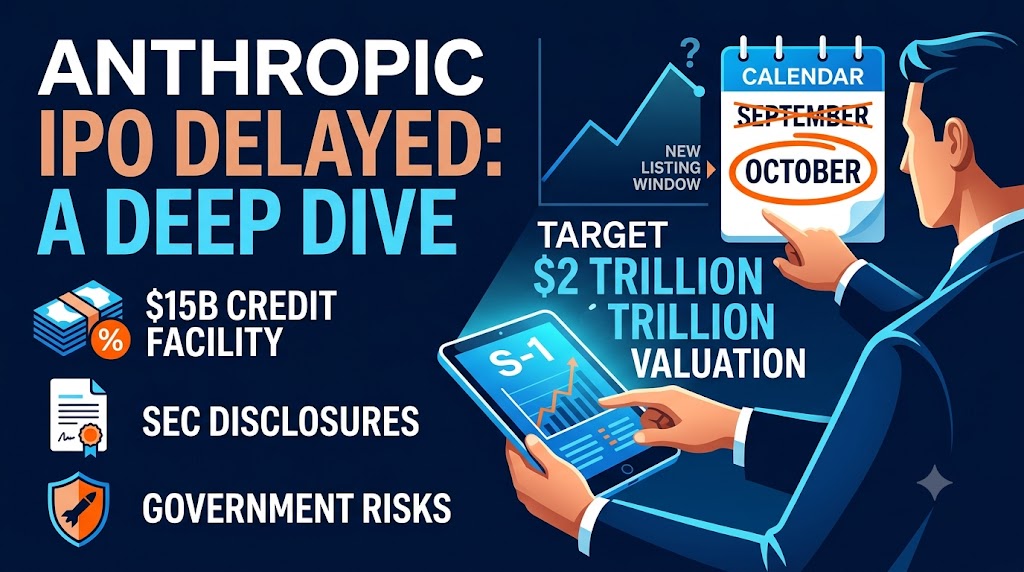
Why Anthropic Delayed Its Massive IPO: A Deep Dive into Capital, Regulations, and Market Realities
The artificial intelligence sector was bracing for what could be the largest public market debut in history. After filing a confidential S-1 draft with the U.S. Securities and Exchange Commission (SEC) in June 2026, Anthropic—the maker of the Claude model family—was widely expected to release its public prospectus and roll out its roadshow by early September.
However, regulatory filings and industry reports confirm that Anthropic has pushed its target listing date back to mid-October 2026.
For retail investors, venture funds, and enterprise clients, this shift raises critical questions. Why would a tech giant with an annualized revenue run-rate topping $65 billion and an estimated valuation nearing $2 trillion pause on the threshold of public markets?
The answer lies at the intersection of massive credit line structuring, complex SEC disclosure windows, defense sector tensions, and strategic market timing.
1. Finalizing a $15 Billion Credit Facility
The most immediate catalyst behind the delayed S-1 prospectus is the ongoing negotiation of a massive $15 billion revolving credit facility.
When tech companies prepare to go public, investment banks do not simply market the stock; they underwrite liquidity structures to backstop post-IPO operational burn. Led by underwriting giants including Morgan Stanley, Goldman Sachs, JPMorgan, and Citigroup, Anthropic is asking participating syndicates to extend upwards of $1 billion each in revolving lines.
- Series H Post-Money Valuation: $965 Billion
- Target Post-IPO Valuation: ~$2.0 Trillion
- Revolving Credit Facility: $15.0 Billion (In Progress)
- Projected 2026 Revenue Run-Rate: $65+ Billion
The sheer scale of this debt facility reflects the capital intensity of modern frontier AI compute. While Anthropic reached an adjusted operating profit in Q2 2026, compute expansion, data acquisition, and custom chip reservations require immediate, multi-billion-dollar liquidity bridges. Finalizing the syndicate terms for a $15 billion credit agreement naturally slowed the timeline for publishing the public prospectus.
2. Navigating SEC Financial Disclosure Rules
Beyond banking logistics, corporate finance strategy plays a decisive role in the delay. Under SEC regulations governing initial public offerings, companies must carefully time their disclosures relative to quarterly earnings cycles.
- The Q2 Advantage: A launch in late October allows Anthropic to present audited financials up to Q2 2026 without officially filing full Q3 results.
- The Valuation Narrative: Q2 2026 marked peak corporate adoption for Anthropic's flagship coding tools, notably Claude Code, which generated over $1 billion in run-rate revenue within six months of release.
- Managing Audit Overhead: Moving the prospectus to late September grants underwriters time to conduct analyst briefings while keeping the listing window constrained before mandatory Q3 disclosure requirements kick in.
By controlling the audit release window, Anthropic maintains maximum leverage over its valuation narrative while insulating its public filing from short-term seasonal fluctuations in enterprise token consumption.
3. Political and Regulatory Pressures: The U.S. Midterm Window
Market sentiment in late 2026 is heavily shaped by macroeconomic and political calendars. Pushing the debut to late October or early November places the IPO directly ahead of the U.S. midterm elections.
Key Timeline Milestones (2026)
- June 1: Confidential S-1 Filing Submitted to SEC
- May - August: Series H Funding & Valuation Hits ~$965B
- Early September: Initial Prospectus Expectation (Delayed)
- Late September: Revised S-1 Public Prospectus Target
- Mid-October: Public Roadshow & Marketing Launch
- Late Oct / Nov: Expected NYSE / Nasdaq Debut
A pre-election debut allows Anthropic to lock in capital before potential regulatory shifts or legislative posturing after the election. However, operating in this tight window requires precise timing to avoid overlapping with high volatility days in global equity markets.
4. Government Risk and Defense Supply Chain Controversies
Unlike some of its competitors, Anthropic faces a unique set of ESG and government risk factors that underwriters are taking extra care to address in draft risk disclosures.
Earlier in 2026, the U.S. Department of War added Anthropic to its supply chain risk list following the company's refusal to relax safety guidelines regarding mass surveillance and autonomous weapons applications. While this stance enhanced Anthropic's reputation among safety-conscious enterprise clients, it locked the firm out of lucrative federal defense contracts that were subsequently awarded to competitors.
With oral arguments heard in federal court in mid-2026, legal counsel and underwriters have had to write comprehensive legal disclosures into the S-1 to protect institutional investors against potential regulatory exposure or government procurement limitations.
Financial Comparison: Anthropic vs. Key Competitor Landscape
To understand why public markets are scrutinizing Anthropic's debut, it is helpful to look at how the company's fundamentals compare across the frontier AI sector.
| Operational Metric | Anthropic (2026 Status) | OpenAI (Projected 2026/2027) |
|---|---|---|
| Annualized Run-Rate Revenue | ~$65 Billion+ | ~$40 Billion |
| Enterprise Market Share | ~34.4% (Leading) | ~32.3% |
| Primary Monetization Driver | Enterprise API, Claude Code, Bedrock | Consumer Subscriptions, Enterprise API |
| Adjusted Operating Profitability | Achieved (Q2 2026) | Targeted (~2030) |
| Target Public Valuation | $1.5T – $2.0 Trillion | $1.0T – $1.5 Trillion |
| Cash-Flow Positivity Target | ~2028 | ~2030 |
Anthropic’s rapid revenue acceleration—growing from an annualized $9 billion at the end of 2025 to over $65 billion by mid-2026—gives it strong fundamental backing. However, sustaining these figures requires non-stop capital deployment into underlying infrastructure.
Strategic Implications and Future Predictions
The decision to delay the listing from September to October is not a sign of fundamental weakness, but rather a calculated effort to optimize structure, capital, and compliance.
1. Front-Running the Frontier Competitors
By listing before OpenAI's projected public offering, Anthropic aims to capture institutional allocation first. Sovereign wealth funds, pension managers, and tech ETF index funds seeking direct equity exposure to pure-play frontier AI will be forced to allocate capital into Anthropic as the premier liquid asset in the sector.
2. The Benchmark for AI Capex Valuation
Anthropic’s debut will serve as a pricing benchmark for the entire tech economy. If public markets reward Anthropic's model of high compute expenditure backed by massive enterprise revenues, it will validate current capital allocation strategies across cloud hyperscalers like Amazon and Alphabet. Conversely, if retail demand falters, market multipliers for AI-adjacent equities could undergo a broad recalibration.
3. The Shift toward Sustainable Enterprise AI
With products like Claude Code proving that AI agent workflows can generate billion-dollar revenue lines in months, public investors will evaluate Anthropic not on raw parameter size, but on revenue retention, net expansion rates, and infrastructure cost management.
Final Thoughts
The temporary pause on Anthropic’s public debut reflects a maturing market. Rather than rushing an unrefined filing to market, Anthropic and its underwriting syndicate are taking the necessary weeks to establish a $15 billion credit safety net, refine risk disclosures, and position the company for a landmark $2 trillion debut.
For investors monitoring the global technology landscape, late October 2026 will mark a major milestone: the moment frontier AI transitions from private venture hype to public market accountability.