10 Content Strategy Tools for Smarter Workflows
Compare 10 content strategy tools for planning, drafting, publishing, and analytics-driven experimentation across SEO and social workflows.
Upkeep · 2026-09-04 · 49 min
The loudest advice in content strategy says to buy a bigger stack, add more dashboards, and let the tools sort themselves out. That usually creates more friction, not less. The better approach is to build a workflow, then choose content strategy tools that each own a specific handoff, from discovery and audience research to drafting, publishing, and measurement.
That matters because content strategy is already a major software market, not a niche helper layer. The content management software market was estimated at USD 34.94 billion in 2025 and is projected to reach USD 77.77 billion by 2033, with North America at 35.2% of global revenue in 2025 (Grand View Research). CMS usage is also entrenched, with WordPress powering 58.9% of all websites using a CMS on 2026-08-31 and holding above 58% across 2018 to 2026 (W3Techs). The practical takeaway is simple. Teams already have publishing infrastructure. The gap is orchestration.
The list below compares ten tools by workflow fit, implementation effort, limitations, and what they teach your team over time. Yubook is especially relevant if your distribution lives on X and Threads, because it connects draft signals, publishing, and post-performance learning in one loop. The rest of the stack covers broader SEO, research, trend, and collaborative operations needs. Treat them as parts of a content operating system, not as isolated features.
Table of Contents
- 1. Yubook
- 2. Semrush Content Toolkit
- 3. Ahrefs
- 4. BuzzSumo
- 5. SparkToro
- 6. MarketMuse
- 7. Clearscope
- 8. Surfer
- 9. StoryChief
- 10. Exploding Topics Pro
- Top 10 Content Strategy Tools, Feature Comparison
- Turn the Shortlist Into a Testable Stack
1. Yubook
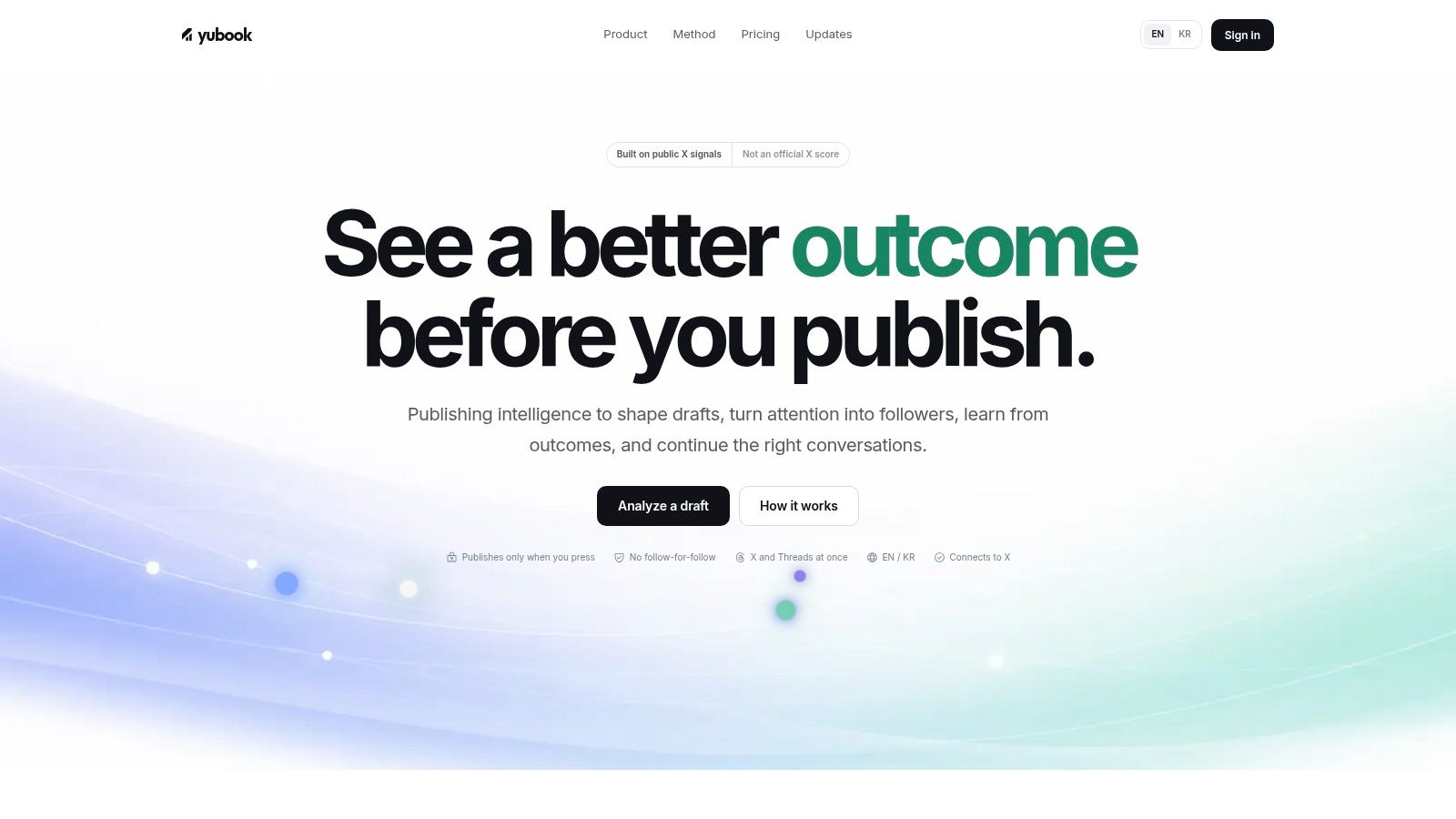
Yubook is the most workflow-specific option here because it starts before publication and keeps learning after the post goes live. Its browser-based draft studio keeps typing on your device, and its pre-publish forecast shows an explainable probability range rather than pretending a social post can be scored with false certainty. That design matters for creators and teams who need to decide whether a draft is likely to travel before they push it live.
Why it fits a social-first operating system
Yubook's core value is that it turns posting into a repeatable loop. It helps you shape a draft with signal-aware guidance, grow through audience diagnostics that link profile visits to follow conversion, learn through performance replay and pattern memory, and continue by prioritizing replies that can borrow readers from relevant conversations. The platform says it supports English and Korean, uses a cookieless visit-counting script, and keeps essential cookies only, which is useful for teams that care about privacy in a more practical than symbolic way.
Practical rule: use Yubook when the team's real problem isn't “What should we post?” but “How do we make every post teach the next one?”
The trade-off is calibration. Its forecasts get more useful as account data accumulates, so a brand-new account won't get the same value as an active one. You also need enough posting volume to let the model learn your account-specific patterns. For creators and social leads, that's not a flaw so much as the price of explainable prediction.
The product page shows two plans on the same engine, Weekly at $9.90/week and Yearly at $249/year. It also shows large-sample product views such as 1.4M+ posts analyzed and 280K+ connected creators, alongside ongoing shipping updates, which signals active development rather than a static feature page. If your content strategy depends on X and Threads, Yubook is the closest thing on this list to a publishing intelligence layer that links draft, distribution, and learning in one place.
2. Semrush Content Toolkit
Semrush sits earlier in the workflow, at the point where teams decide what deserves a brief at all. The Content Toolkit is built around topic discovery, content ideas, SEO briefs, optimization, and reporting, so it works best when a draft still needs structure, not just polish. For teams that turn one core idea into a blog post, a thread, and a newsletter excerpt, that upstream planning layer matters.
Where it helps and where it slows you down
Semrush's strength is the depth of its data. It plugs into Semrush's keyword and competitor datasets, which makes it useful for validating whether a topic has enough search or competitive relevance to justify production time. The downside is breadth. The broader SEO environment can feel heavy if your primary channel is social, and the add-on model can make the total cost harder to predict as the stack grows.
For teams that want a single planning source, Semrush can anchor the research phase and hand off into drafting. The problem comes when the handoff stops there. SEO briefs don't automatically create a publishing cadence, and they rarely explain what happens after a post goes live. That's why a team using Semrush for planning often needs a second system for execution or measurement, especially if the same content will be adapted for X or Threads.
The best implementation choice is to define Semrush as the place where a topic becomes a brief, then force a clean transfer into the drafting tool your team uses. If you let it expand into everything, it becomes a general-purpose suite. If you keep it focused on discovery and brief generation, it stays useful.
Track the handoff from planning to published performance in Yubook's views-dropped guide, especially if you're trying to understand whether a topic failed because of positioning, timing, or distribution.
3. Ahrefs
Ahrefs is the strongest fit when you need to validate an angle against the search environment before repurposing it into social content. Its Keywords Explorer, Content Explorer, rank tracking, site audit, and competitive gap analysis make it useful for seeing how a topic behaves in the broader SEO ecosystem. That's valuable even for teams that don't publish much long-form content, because good social posts often start as sharpened versions of search-informed ideas.
Use it as a validation layer, not a publishing layer
Ahrefs works best when research discipline matters more than content volume. It gives you a way to test whether a competitor owns a topic, whether a search result is crowded, and whether the angle is worth building around. The trade-off is that it stays close to SEO. Social-only teams will probably use a subset of its capabilities, and costs can rise as usage and users grow.
Its plan structure is clearer than many enterprise platforms, which makes it easier to trial with a smaller team. That's useful if you're trying to decide whether your workflow needs deep crawling and link intelligence or just a few repeatable research passes each month. The key implementation choice is to keep Ahrefs upstream of production. It is better at telling you what deserves attention than what deserves to be published tomorrow at 9 a.m.
One practical use case is to validate whether a blog-worthy topic should be broken into multiple smaller social assets. Another is to compare your likely angle with competing pages before a writer spends hours drafting. If you're managing a content system, Ahrefs belongs in the research and gap-analysis stage, then hands off to a planning or drafting layer that can translate the findings into usable output.
Review Yubook's measurement notes after publishing, because the test is not whether a topic ranked in research, but whether it translated into measurable reader behavior.
4. BuzzSumo

BuzzSumo is the fastest way on this list to see what's resonating across the web. Its Content Analyzer, trending feeds, Question Analyzer, media database, outreach tools, and alerts make it useful for teams that want signal before they commit to production. If your workflow starts with “What are people already reacting to?” this is a strong first stop.
Best for timely topics and outreach
The tool's real advantage is breadth of surface area. It helps you spot themes across platforms, including social and forum-like contexts, and it supports outreach to journalists and influencers when amplification is part of the plan. That makes it valuable for teams that need both topic discovery and distribution support.
The limitation is equally clear. BuzzSumo is not a rank-tracking SEO suite, so it complements rather than replaces tools like Semrush or Ahrefs. It tells you what is getting attention. It doesn't tell you whether a page will win search visibility next quarter. That distinction matters if your team mixes social, PR, and SEO in the same calendar.
The strongest use of BuzzSumo is not “find a viral idea,” it's “find a topic that already has proof of attention, then decide whether your team can add a better angle.”
For a content operating system, that means BuzzSumo belongs in the demand-discovery layer. Use it to populate the backlog, build outreach lists, and pressure-test whether a topic is timely enough to justify writing now. Then pass the chosen idea into a brief, an editorial calendar, or a social publishing workflow.
Check Yubook's timing guidance for social publishing when you want to turn that demand signal into a post that lands during the right attention window.
5. SparkToro
SparkToro is the clearest audience research tool in this group because it answers a different question than most SEO software. Instead of asking what people search for, it shows which sites, podcasts, YouTube channels, and social accounts they pay attention to. That makes it useful for identifying the creators, communities, and channels your content should borrow credibility from.
Audience mapping before content production
Good content strategy starts with audience reality, not brand preference. SparkToro helps you find attention sources, then turn those findings into tasks through its “Take Action” suggestions. For strategists, that makes it more than a discovery tool. It becomes a planning aid for where to show up, who to monitor, and which communities deserve reply activity.
The trade-off is that SparkToro isn't a publishing or analytics suite. It won't draft the post, schedule the post, or measure the result after it ships. It is upstream by design, and that's a strength if you want clean boundaries in your stack. It is also one of the easier tools to justify for message-market fit work, because it gives you a sharper sense of where your audience already spends attention.
The API and credit-based access open the door to custom dashboards, which makes SparkToro interesting for teams that want audience research to feed directly into internal ops. That said, pricing specifics can vary by plan and API credits are separate, so it's worth deciding whether you need the interface, the API, or both.
Use Yubook's best-time guidance after you map your audience, because timing only matters once you know which conversations your readers are already in.
6. MarketMuse
MarketMuse belongs in the strategy and inventory layer, especially for teams with a large content library. Its content inventory, topic modeling, personalized difficulty metrics, and content scoring are designed to help you decide what to publish, refresh, or deprioritize. That makes it more useful for content operations than for quick ideation.
Stronger for libraries than for single posts
The product's value comes from structure. It helps teams think about topic authority and content coverage across a broader set of assets, which is where many content programs get messy. Instead of asking whether one article is good enough, MarketMuse asks whether the library has the right mix of coverage, depth, and competitive opportunity.
That's a good fit for organizations with old content, overlapping briefs, and unclear prioritization. It's less helpful for lean teams that just need a fast research-to-post workflow. The learning curve reflects that difference. If you're managing a library, the setup cost can pay back in better prioritization. If you're managing a small creator workflow, it can feel like too much system for too little throughput.
MarketMuse also generates briefs across multiple content formats, which is useful when one idea needs to become an article, FAQ, or comparison piece. That makes it a good bridge between planning and creation. The key implementation choice is to treat it as the source of truth for inventory and topic coverage, not as a universal production platform.
7. Clearscope
Clearscope is one of the cleanest optimization tools for teams that want guidance without clutter. It focuses on search intent, language patterns, content scoring, and now includes prompt and brand visibility tracking across Google and AI answers. That makes it especially relevant for teams producing cornerstone content that will later be chopped into social posts, summaries, or founder-led commentary.
Simple enough for non-SEO writers
Its biggest advantage is usability. Writers and editors can work inside a clearer interface than many heavier SEO platforms, which reduces the onboarding burden for teams that don't live in keyword tools every day. The plan structure is also transparent enough to understand, although draft and page credit limits can matter if the team publishes at high volume.
Clearscope is better at page-level optimization than broad rank tracking. That's not a weakness if you want editorial quality control. It is a weakness if you expect a single tool to manage the entire search portfolio. The right implementation pattern is to use it downstream from research, where the brief already exists and the draft needs refinement before launch.
Because it tracks visibility in both search and AI-answer environments, it's also useful for teams that care about how wording travels beyond a traditional SERP. That doesn't replace strategy. It gives editors a more immediate surface to optimize against.
8. Surfer

Surfer is built for on-page optimization and repeatable brief workflows. The Content Editor, site auditor, AI writing options, and playbooks give teams a structured way to move from draft to publishable page. It's popular for a reason. The guidance is direct, and the workflow is easy to repeat.
Useful when you need repeatable editorial standards
That repeatability is the appeal. Smaller teams and solo marketers often need a system that tells them what to include, what to revise, and how to keep content aligned to intent without inventing a process from scratch. Surfer does that well. It also has a clear downside. The checklist style can feel constraining if your team wants more editorial freedom.
Cost is the other factor. There's no free version, and per-article credits plus AI add-ons can raise the total as output scales. That makes budgeting important before you standardize on it. If your team plans to produce a lot of assets, Surfer can become an always-on operating cost rather than a one-time software purchase.
Surfer fits best when the workflow begins with a draft that already has a topic and intent. It then helps shape the page into something more aligned with the competitive environment. For social teams, the payoff usually comes later, when a well-optimized article can be broken into sharper posts, cleaner hooks, and better follow-up threads.
9. StoryChief
StoryChief is the most operationally complete collaboration tool in this set. It combines editorial planning, social calendars, approvals, AI-assisted briefs and post drafting, multi-platform publishing, and analytics. If your content team has more than one stakeholder, and especially if publishing touches blog, email, and social, it's one of the clearest coordination layers available.
Best for teams that need approvals and distribution in one place
The strength here is reducing handoff loss. Teams can plan, approve, and distribute inside a shared system rather than stitching together spreadsheets, chats, and separate schedulers. That's valuable for agencies and marketing teams that need multiple people to touch a piece before it goes live.
The downside is complexity. StoryChief can feel heavy for solo creators, because the coordination features matter most when there are handoffs to manage. Pricing also varies by seat and plan, so it's more of an operations decision than a quick utility purchase. If you're choosing it, be clear about who owns editorial review, who publishes, and which channels the platform must cover.
StoryChief's value is strongest when your workflow already exists but keeps breaking at the edges. It can reduce the number of places work gets lost. It can also make the output easier to audit because planning, approvals, and publishing sit closer together.
10. Exploding Topics Pro
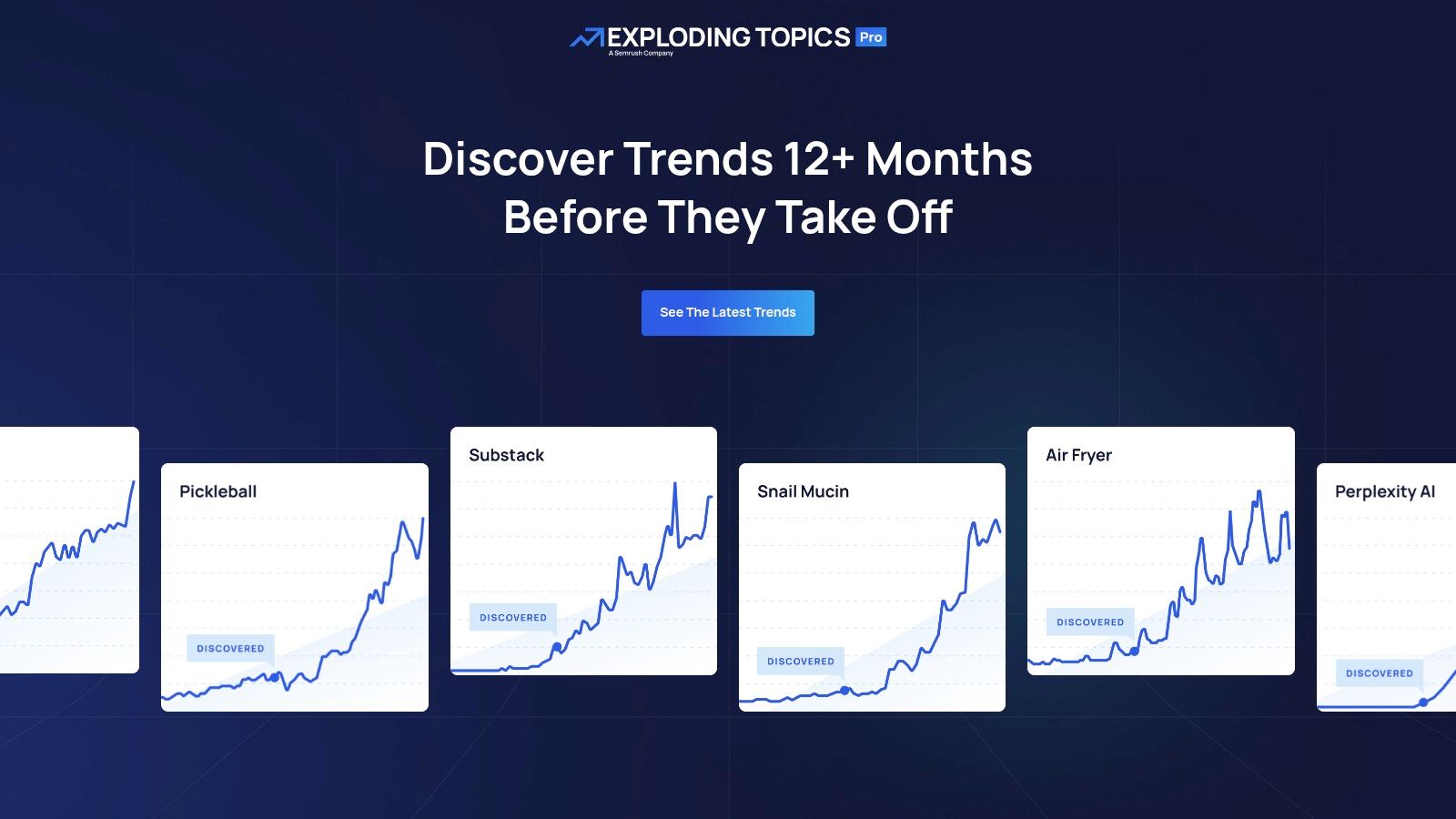
Exploding Topics Pro is a trend discovery tool, which makes it different from SEO suites that focus on existing demand. Its tracked trends, forecasting, Meta Trends, company and product reports, and CSV export features make it useful for timing experiments and finding emerging angles before a topic feels overcrowded.
Good for “why now” content
This is the tool you use when you need a reason to publish now rather than later. It helps backlog planning and can surface topics that are just starting to accelerate. That makes it a strong companion to scheduling tools, because it can influence when a topic enters the editorial queue.
The limitation is clear. It's trend discovery only. It won't write the post or run the publishing workflow, and its Pro tier focuses on curated trends rather than an all-purpose research environment. That's fine if you already have a separate system for drafting and scheduling.
The best use case is pairing it with a more durable planning stack. Let Exploding Topics Pro tell you which themes deserve experimental coverage, then move the chosen topics into your SEO, editorial, or social workflow. For teams that publish on fast-moving platforms, that early signal can be the difference between a timely angle and a stale one.
Top 10 Content Strategy Tools, Feature Comparison
| Product | Core focus & key features | Target audience | Unique selling points | Typical pricing |
|---|---|---|---|---|
| Yubook (Recommended) | Draft signal analysis, explainable forecast, AI-assisted rewrites, one-click X & Threads publish, reply queue | Creators & small teams active on X/Threads | Browser-based local drafting, probability ranges (uncertainty shown), cookieless visit counting, growth sprints | $9.90/week or $249/year (Paddle) |
| Semrush – Content Toolkit | Topic discovery, content briefs, on-page optimization, reporting | Content marketers & SEO teams | Deep keyword/competitor dataset, modular workflows, strong training resources | Modular pricing; add‑ons may increase cost |
| Ahrefs | Keyword & content explorer, link data, rank tracking, audits | SEO teams & competitive researchers | Robust crawling/index, clear limits, SERP history & competitive views | Tiered plans; costs scale with usage/add‑ons |
| BuzzSumo | Content discovery, trend analysis, media database, monitoring | PR teams, content strategists, outreach specialists | Fast cross‑platform validation, media/outreach workflows, alerts | Tiered; Suite/Enterprise are pricier |
| SparkToro | Audience research & attention mapping, audience sources | Social strategists, researchers, outreach planners | Niche audience discovery, "Take Action" suggestions, API access | Pay‑as‑you‑go API credits; plan pricing varies (discounts available) |
| MarketMuse | Content inventory, topic authority scoring, brief generation | Large content teams prioritizing topical authority | Strategy-level guidance, topic modeling, content prioritization | Free tier; paid/enterprise tiers require sales contact |
| Clearscope | Page‑level optimization, search intent guidance, content scoring | Editorial teams optimizing for search & clarity | Simple plan structure, quick onboarding, writer-friendly UI | Transparent plans; draft/page credit limits may apply |
| Surfer (SurferSEO) | NLP-based content editor, audits, brief generation, playbooks | Solo marketers and small content teams | NLP suggestions, repeatable playbooks, editor & audit workflows | No free version; per-article credits and AI add‑ons increase cost |
| StoryChief | Editorial calendar, approvals, multi‑channel publishing, analytics | Agencies and collaborative teams managing multi-channel publishing | Consolidates planning, approvals & publishing (incl. Threads/X), analytics | Seat‑based pricing; varies by plan and features |
| Exploding Topics Pro | Trend discovery and forecasting, meta‑trends | Strategists and content planners timing experiments | Large tracked trend dataset, forecasting for emerging angles | Pro tiers with caps; 7‑day free trial on paid tiers |
Turn the Shortlist Into a Testable Stack
The right stack starts with the job, not the vendor. If you need to discover demand, start with BuzzSumo, SparkToro, or Exploding Topics Pro. BuzzSumo shows what's getting attention, SparkToro shows where your audience already pays attention, and Exploding Topics Pro helps you catch emerging themes before they fully mature. Those are different signals, and you shouldn't force one tool to do all three.
If the job is to validate and brief SEO work, use Semrush, Ahrefs, MarketMuse, Clearscope, or Surfer. Semrush and Ahrefs are stronger when research depth and competitive context matter. MarketMuse is better for large libraries and prioritization. Clearscope and Surfer are stronger when the draft already exists and the team needs clear page-level optimization guidance. Their trade-offs are practical, not cosmetic. Some are better for planning, some for editing, and some for library management.
If the job is collaboration and publishing, StoryChief is the clearest coordination layer. It reduces the number of places approval, calendar management, and distribution can break. If the workflow centers on X and Threads, Yubook is the most purpose-built option here because it connects pre-publish forecasting, publishing, measurement, audience conversion, and prediction-versus-actual learning in one loop.
The strongest implementation sequence is usually the same. Choose one primary planning source, define the handoff into drafting and publishing, establish a small set of outcome metrics, and review experiments on a fixed cadence. A team that does that will learn faster than a team that buys more software. The best stack is the one that removes workflow gaps and creates reusable learning, not the one with the longest feature list.
Yubook gives creators and teams on X and Threads a way to move from guesswork to a repeatable content system. It connects draft analysis, publishing, audience growth, and post-performance learning so each post improves the next one. Visit Yubook if you want a publishing intelligence workflow that fits the same content strategy discipline this guide describes.