How to Grow on Threads: Tactics That Actually Convert
Learn how to grow on Threads with step-by-step tactics for drafting, replies, timing, and cross-posting from X. Includes experiment designs and conversion tips.
Upkeep · 2026-08-26 · 35 min
Most advice on how to grow on Threads starts with a publishing quota. Post constantly, fill the feed, and hope repetition creates momentum. That approach can produce activity without producing an audience. The more useful question is what happens after someone sees your post: do they join a conversation, visit your profile, and find a clear reason to follow?
Threads has expanded rapidly, from 175 million monthly active users on July 3, 2024, to 500 million by June 16, 2026, according to Reuters' coverage of Threads' user growth. That expansion creates opportunity, but reach alone won't build a durable account. The practical growth loop is relevant discovery, useful replies, profile conversion, and repeat visits. Posting is only one input.
Table of Contents
- Why Posting More Is Not the Growth Lever You Think
- Drafting Posts That Earn Reach Before You Publish
- Reply Strategy That Borrows Readers From Larger Accounts
- Timing and Cross-Posting From X Without Losing Momentum
- Turning Profile Visits Into Followers With Conversion Experiments
- Your Seven-Day Growth Experiment Plan
Why Posting More Is Not the Growth Lever You Think
Publishing more often feels measurable, which is why creators default to it. You can count posts, schedule them, and finish the day believing that output equals progress. But a crowded publishing schedule can hide a weak discovery system. If your posts don't enter conversations or give visitors a compelling reason to follow, extra volume mostly creates more isolated assets.
The stronger model treats original posts as conversation starters and replies as distribution. A post can reach people who already follow you, while a thoughtful reply under a relevant account can place your expertise in front of an audience that has no reason to know you yet. That distinction matters more than a rigid daily quota.
Practical rule: Publish enough to establish your point of view, then spend serious attention where your ideal readers are already talking.
A useful comparison looks like this:
| Metric | High-Frequency, 5+ posts/day | Reply-Driven, 1-2 posts/day + 15 replies |
|---|---|---|
| Primary activity | Feed output | Relevant conversations |
| Discovery source | Existing audience and incidental recommendations | Adjacent accounts and active reply chains |
| Profile experience | More posts to review, sometimes repetitive | Clearer point of view supported by useful participation |
| Main risk | Fatigue, diluted ideas, shallow engagement | Time spent on replies that lack relevance |
| Growth question | Did I publish enough? | Did the right readers visit and convert? |
The reply-driven approach doesn't mean frequency is irrelevant. Consistency gives new visitors enough evidence to understand your subject, while fresh posts create destinations for people who discover you through replies. The trade-off is resource allocation. A creator with limited time usually learns more by improving one strong post and writing targeted replies than by producing several interchangeable updates.
Buffer's analysis of more than 128,000 Threads posts found that posts where creators replied to comments received about 42% higher engagement on average, with roughly two-thirds of profiles showing a positive effect, as reported in Sprout Social's Threads statistics roundup. That result doesn't prove every reply will work, but it supports a practical conclusion: replies aren't maintenance work after publishing. They're part of the content.
The algorithm remains difficult to reduce to one visible formula, so don't build your strategy around claims about a single ranking signal. Build around behavior you can observe: which replies attract profile visits, which topics generate sustained discussion, and which profile versions turn curiosity into follows.
Drafting Posts That Earn Reach Before You Publish
A strong Threads draft gives readers a clear reason to respond. Before writing, identify the conversation you want to enter. Search for accounts in your niche discussing the problem, objection, or decision your post addresses. Look for active reply chains, not just posts with large visible engagement. A lively discussion tells you that readers have context and opinions already available.
Then write the post around one conversational job. It might ask readers to choose between two approaches, challenge a common assumption, or offer a practical extension to an existing idea. Avoid combining a lesson, product pitch, personal update, and unrelated question in one short post. A focused post makes the reply path obvious.
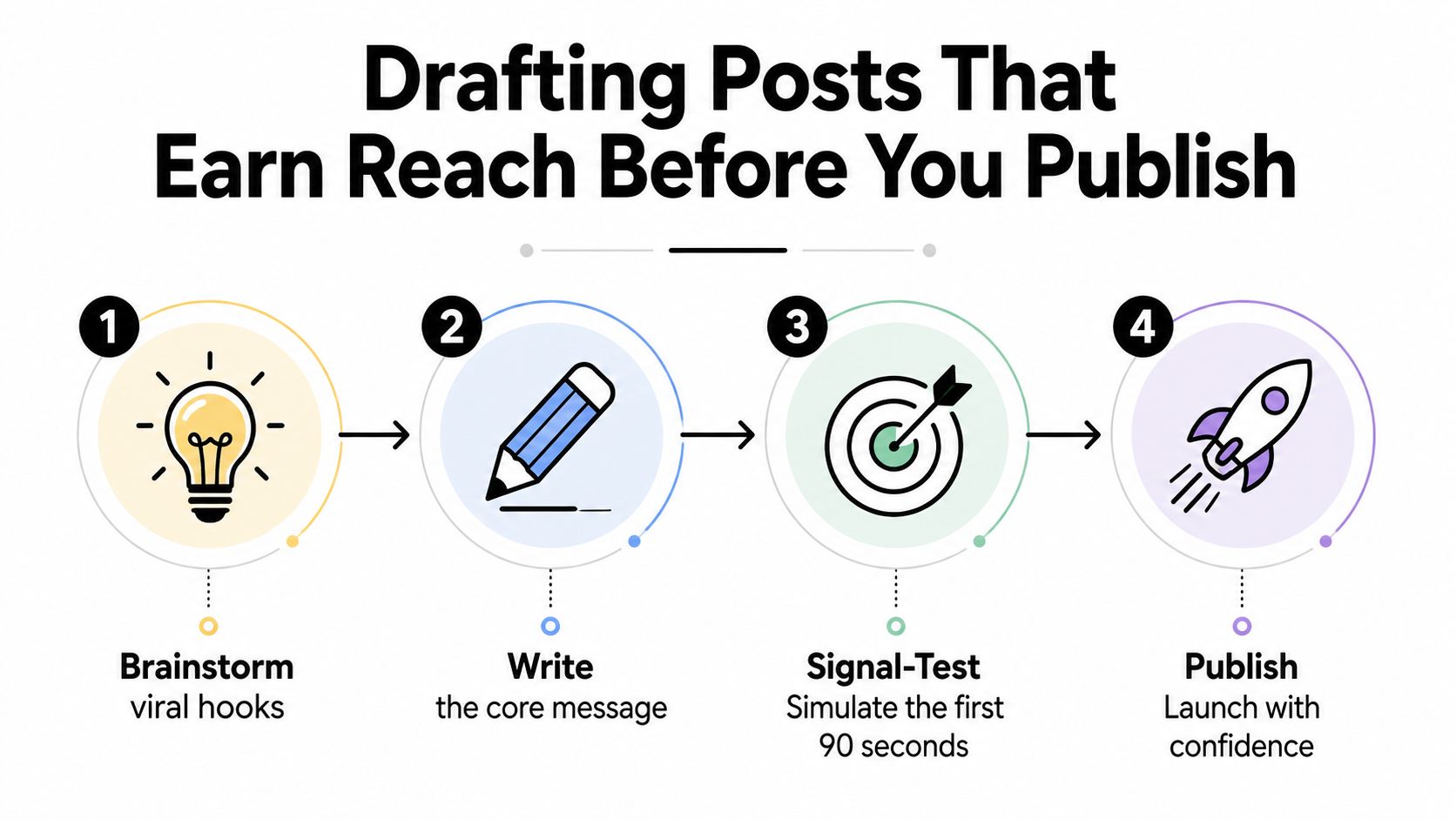
Three hooks that invite a response
Pattern interrupt: Replace a familiar recommendation with a sharper observation.
- Weak: “Posting consistently helps you grow on Threads.”
- Stronger: “More Threads posts won't fix a profile that gives visitors no reason to follow.”
Contrarian take: Disagree with the default advice, then explain the condition behind your view.
- Weak: “Reply to other creators to grow.”
- Stronger: “The fastest replies to write are often the least valuable. Readers notice when you repeat the original post instead of adding something.”
Curiosity gap: Present a specific tension without withholding the useful answer.
- Weak: “I changed my Threads strategy.”
- Stronger: “My original posts looked fine in analytics, but replies were doing the discovery work. The change was simple: I measured profile visits separately from post engagement.”
The hook should lead naturally to a response. A good question isn't “Thoughts?” That prompt asks readers to do the work of inventing a direction. Try a narrower invitation instead: “Which part breaks first in your workflow, topic selection or follow-up?” or “What would you add before publishing this?”
Forecast before launch
Use a short pre-publish check:
- Topic fit: Is the subject connected to your account's stated promise?
- Conversation fit: Are relevant people already discussing it?
- Reply surface: Can a reader disagree, add an example, or ask a useful question?
- Profile path: If the post works, will a profile visitor understand what they'll get by following?
- Follow-up capacity: Can you stay available to respond after publishing?
Forecasting doesn't mean pretending you can know the outcome. It means writing down the expected audience, likely response type, and profile action before the post goes live. Later, compare that forecast with actual replies, visits, and follows. The gap is more useful than a vague feeling that a post “did well.”
Reply Strategy That Borrows Readers From Larger Accounts
The most overlooked distribution channel on Threads is the audience attached to someone else's active post. You don't borrow that audience by dropping a compliment or inserting your offer. You borrow attention by making the original conversation more useful.
Start with a focused watchlist of accounts whose readers match your target audience. Relevance matters more than fame. A large account with a general audience may generate visibility but few qualified profile visits, while a smaller specialist can attract people who understand your subject immediately.
When a relevant post appears, read the existing replies before writing. Repeating the author's point adds little. A strong reply should make sense beside the original post and still reveal how you think.
Three reply patterns that earn profile curiosity
The additive insight supplies a missing detail. If the original post discusses launching a product, you might add a distinction between collecting sign-ups and observing activation behavior. The reply should stand on its own, not tease readers into your profile.
The respectful counterpoint identifies a boundary or trade-off. “That works when the audience already knows the problem. For a new category, the first task is often naming the pain clearly.” This creates discussion without turning disagreement into performance.
The tactical extension converts an idea into an action. Add a prompt, checklist, decision rule, or diagnostic question that readers can use immediately. Tactical replies often create more curiosity than self-description because they demonstrate capability directly.
Industry coverage cites the same about 42% engagement lift when creators reply to replies, as summarized by Promote's analysis of Threads for creators. Treat that as directional evidence, not a guaranteed outcome. The quality of the reply, the relevance of the original audience, and the timing of the conversation still determine whether attention turns into visits.
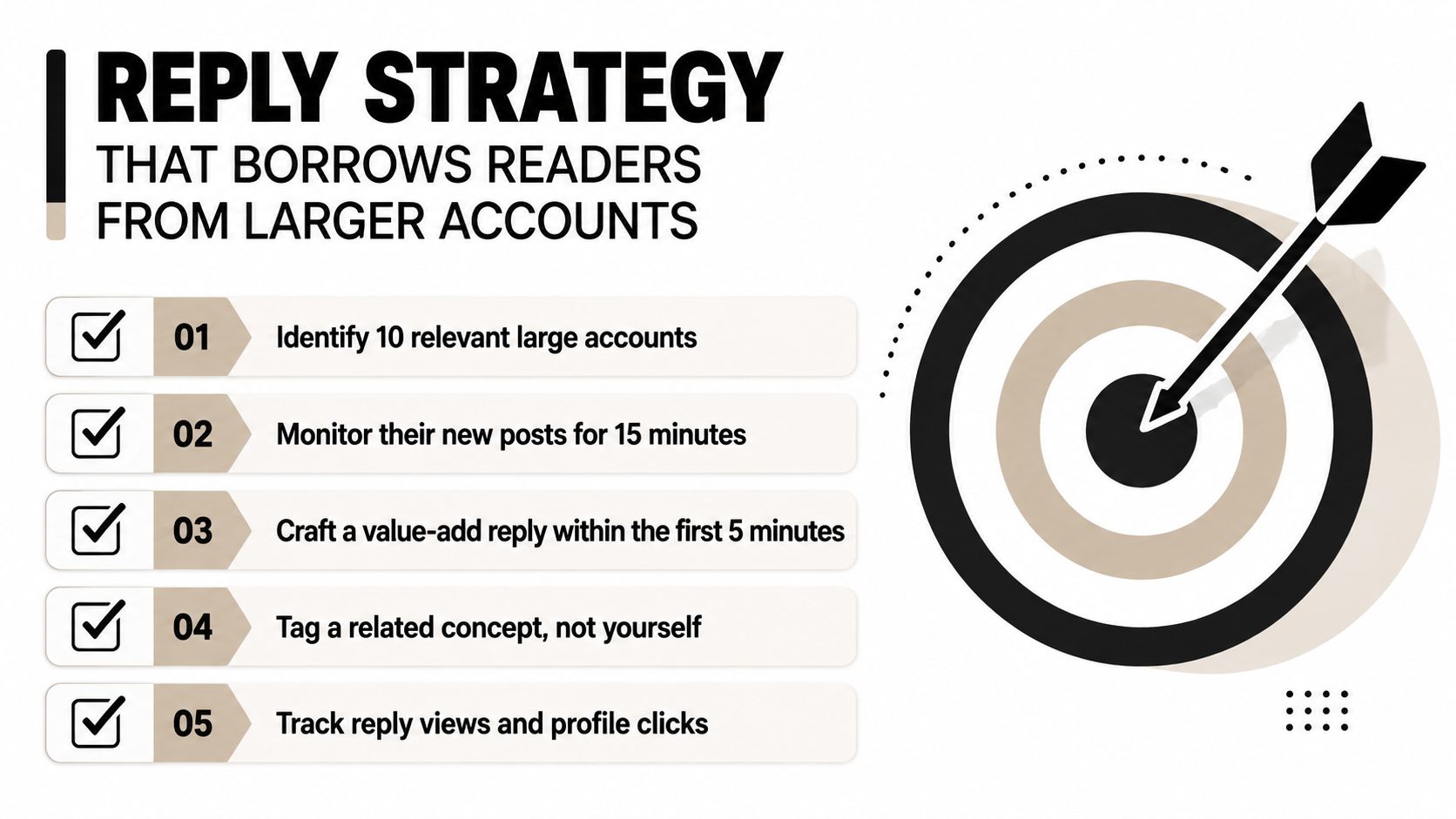
Decide where your time belongs
Score a potential reply using four questions:
- Audience overlap: Would the original post's readers care about your subject?
- Conversation openness: Are people asking questions or building on the post?
- Distinct contribution: Can you add something the existing replies don't?
- Profile readiness: Does your profile support the claim your reply implies?
Prioritize posts where all four answers are clear. Don't force a reply to every high-visibility post. Generic praise, premature self-promotion, repeated advice, and unexplained jargon can make your account look extractive. The objective isn't to appear everywhere. It's to become recognizable for making useful contributions in a specific set of conversations.
Timing and Cross-Posting From X Without Losing Momentum
Cross-posting works when you reuse an idea, not when you duplicate the artifact. X readers may accept compressed terminology, threaded context, or a link-led call to action. Threads often benefits from a more self-contained observation that gives readers an immediate opening for discussion.
Use X analytics to find posts with a clear response pattern, then rewrite the premise for Threads. Remove platform-specific references, explain any shorthand, and replace “read the full thread” with a question or practical choice. If the original contains several connected points, select the strongest one rather than transferring every sentence.
The exact timing should come from your audience's behavior, not a universal schedule. Keep a record of when posts receive meaningful replies and when profile visits follow. Leave enough space between related posts so you can identify which version generated the response. Publishing two near-identical ideas close together makes the result harder to interpret and can split attention.
| Element | X, formerly Twitter | Threads |
|---|---|---|
| Starting point | Short claim, thread, link, or fast reaction | Self-contained idea with a clear reply path |
| Repurposing move | Preserve compressed language when the audience understands it | Expand context and remove insider shorthand |
| Call to action | Often click or thread continuation | Invite a specific response or perspective |
| Media decision | Use the format that supported the original result | Add media only when it clarifies the idea |
| Measurement | Review engagement and clicks | Separate conversation, profile visits, and follows |
A browser-based workflow such as Yubook's X and Threads publishing workspace can help keep the draft, platform adaptation, and result review together. The tool doesn't remove the strategic decision. You still need to decide whether the idea deserves a second life and what should change before it reaches Threads.
Turning Profile Visits Into Followers With Conversion Experiments
A profile visit is evidence of curiosity, not success. The visitor may have liked your reply, recognized a problem in your post, or clicked to identify you. Your profile has only a short opportunity to connect that curiosity to a clear promise.
Treat the page as a landing experience. The bio should explain who you help, what you discuss, and what a new follower can expect. The pinned post should reinforce that promise with a useful example, not just announce that you're building in public. If a reply attracts readers interested in onboarding, a profile dominated by unrelated personal updates creates a conversion mismatch.
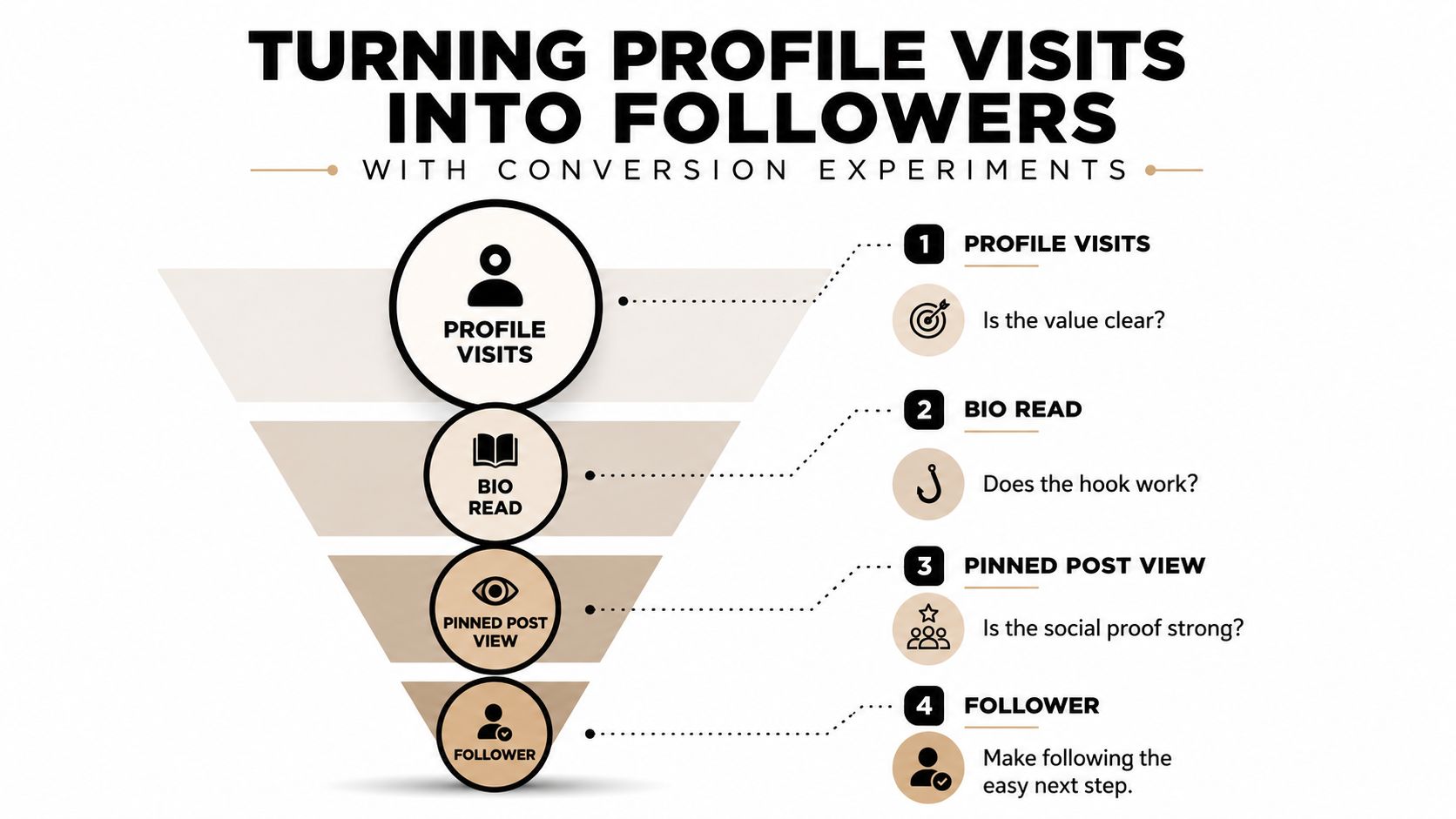
Build a forecast-versus-actual test
Start with a hypothesis: “A bio that names the audience and recurring topic will turn more profile curiosity into follows than a bio centered on personal credentials.” Choose one change, keep the surrounding profile stable, and define the observation window before you begin.
Track the path in order:
- Profile visits: Did the reply or post attract qualified curiosity?
- Bio engagement: Does the promise make sense quickly?
- Pinned post views: Does the proof support the promise?
- Follows: Did the visitor decide that future updates are worth receiving?
Don't change the bio, pinned post, link, and content theme at the same time. If the result improves, you won't know which change mattered. If it falls, you won't know what to restore. Native analytics can show useful directional movement, but your notes should also record the source post, audience context, and reply quality.
A measurement platform such as Yubook can connect profile visits with follow conversion and compare predicted outcomes with later performance. Its value in this workflow is diagnostic: it helps separate public signals from measured results so you can revise your assumptions instead of celebrating visits that never become an audience.
Your Seven-Day Growth Experiment Plan
A short experiment should test behavior, not validate a predetermined belief. Before the first day, write down your forecast for each post and reply: expected conversation quality, likely profile interest, and the action you want visitors to take. Then preserve enough consistency to identify what changed.
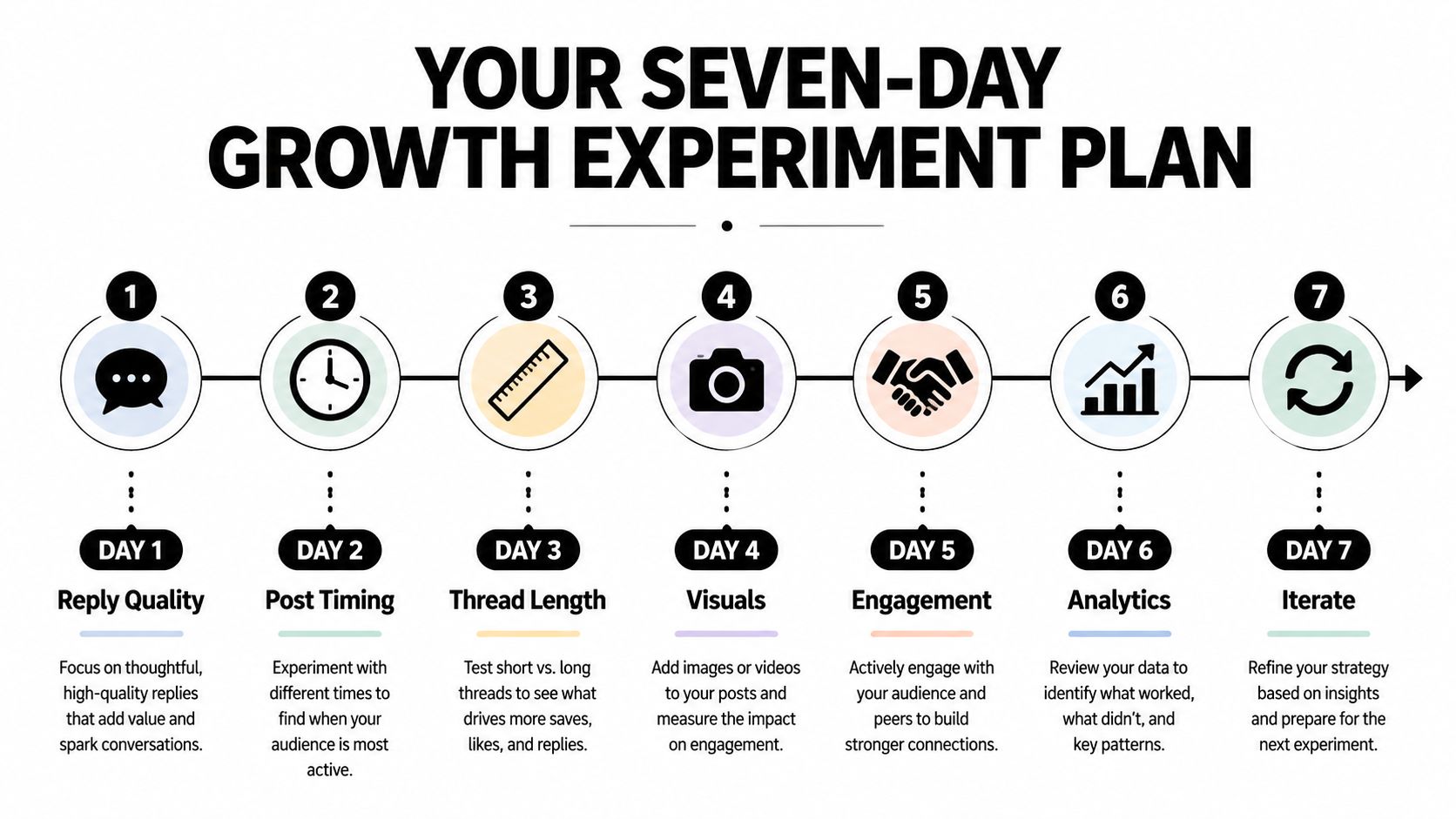
The daily sequence
- Day 1, reply quality: Choose a narrow topic and write replies that add an insight, counterpoint, or tactical extension. Record which replies generate profile curiosity.
- Day 2, post timing: Publish one focused post during a period your audience appears active. Compare the quality and speed of responses with your usual pattern.
- Day 3, thread length: Test a concise standalone idea against a post that needs a short continuation. Judge which format produces clearer replies, not merely more impressions.
- Day 4, visuals: Use a visual only when it clarifies the argument. Compare whether the media attracts relevant discussion or just passive attention.
- Day 5, engagement: Reserve time after publishing for comment follow-up. Treat each response as another chance to clarify the idea and strengthen the conversation.
- Day 6, analytics: Review post replies, profile visits, follows, and repeat visits separately. Identify where the funnel weakens.
- Day 7, iterate: Keep the tactic that beat its forecast for the right reason. Revise or remove the tactic that looked promising but produced unqualified attention.
For timing ideas, consult Yubook's guidance on the best time to post, then validate those suggestions against your own audience. A forecast-versus-actual review should ask three questions: What did I predict, what happened, and which assumption explains the difference?
The result isn't a universal posting formula. It's an account-specific operating system. Keep a record of successful reply contexts, profile promises, topics, and follow-up habits. Scale the combinations that repeatedly attract the right readers, and stop spending time on tactics that produce visible activity without conversion.
Yubook helps creators and teams draft for X and Threads, analyze public ranking signals, forecast likely reach, and connect profile attention with follower conversion. Visit Yubook to turn your next Threads experiment into a measured publishing workflow.