Personal Branding for Founders: A Practical 2026 Playbook
A practical 2026 playbook on personal branding for founders, covering positioning, X and Threads formats, follow conversion metrics, and iteration loops.
Upkeep · 2026-09-08 · 42 min
“Post more and be authentic” is weak founder-brand advice. It gives you an activity target and a personality instruction, but neither tells you why a reader should follow, what they should remember, or how attention becomes a business result.
Personal branding for founders works when it behaves like a measurable distribution system. Your content should establish a position, attract a defined audience, earn profile visits, convert the right visitors into followers, and create repeat exposure that supports sales, hiring, partnerships, or fundraising. Impressions matter only when they produce those next actions.
The case for treating founder visibility as a trust asset is stronger than the usual vanity-metric conversation. A widely cited benchmark summarized by Rethoric's founder branding research says 44% of company market value is tied to CEO reputation, while 67% of Americans would spend more with companies whose founder's personal brand aligns with their values. The same research stream reports that 82% believe companies are more influential when executives have a personal brand people know and follow, and 74% are more likely to trust someone with an established personal brand.
The operating question is simple: can you diagnose the path from post to qualified follower? This playbook uses four systems, positioning, signature formats, cadence and replies, and a forecast-versus-outcome iteration loop.
Table of Contents
- Why Founder Branding Is a Measurable Trust Asset
- Define Your Positioning and Audience Before You Post
- Build Signature Content Formats That Compound
- Set a Publishing Cadence and Reply Strategy
- Track Follow Conversion Instead of Vanity Numbers
- Use Yubook to Iterate on Every Draft
- Your 30 60 90 Day Founder Branding Roadmap
Why Founder Branding Is a Measurable Trust Asset
The highest-impact output of a founder's personal brand isn't reach. It's the conversion rate from a curious reader into a qualified follower who returns, replies, clicks, and eventually enters a business conversation.
That distinction changes how you work. A post with broad distribution but weak profile visits may be entertaining without being strategically useful. A smaller post that attracts the right operators, earns thoughtful replies, and drives repeat profile visits can create more commercial value. Your dashboard should therefore resemble a growth funnel, not a popularity scoreboard.
Track the path:
- Impressions: Did the platform distribute the post?
- Profile visits: Did the argument create enough curiosity to inspect the founder?
- Follows: Did the profile promise a useful future?
- Repeat visits: Did the reader remember the account and return?
- Reply depth: Did the post create a conversation with relevant people?
- Business action: Did attention influence a click, call, application, hire, or buyer conversation?
A founder brand becomes valuable when each stage has a clear job. Credibility earns the first pause. Specificity gives the reader a reason to care. Reply utility exposes your thinking to adjacent audiences without relying entirely on your own distribution. Broad likeability can help, but it's rarely enough to make a technical buyer trust your judgment.
Practical rule: Score founder content on conversion economics, not impressions alone.
The broader B2B environment supports this shift. The 2024 Edelman-LinkedIn B2B Thought Leadership Impact Report is summarized as finding that 73% of B2B decision-makers trusted thought leadership more than marketing materials, and 75% said thought leadership prompted them to consider a product or service they hadn't previously considered. Founder-led content can serve as the first trust bridge, especially when the company is young and the founder remains the clearest signal of competence and conviction.
Your brand doesn't need to reveal every part of your personality. It needs a recognizable point of view, evidence behind it, and a publishing system that makes the point of view easy to find and remember.
Define Your Positioning and Audience Before You Post
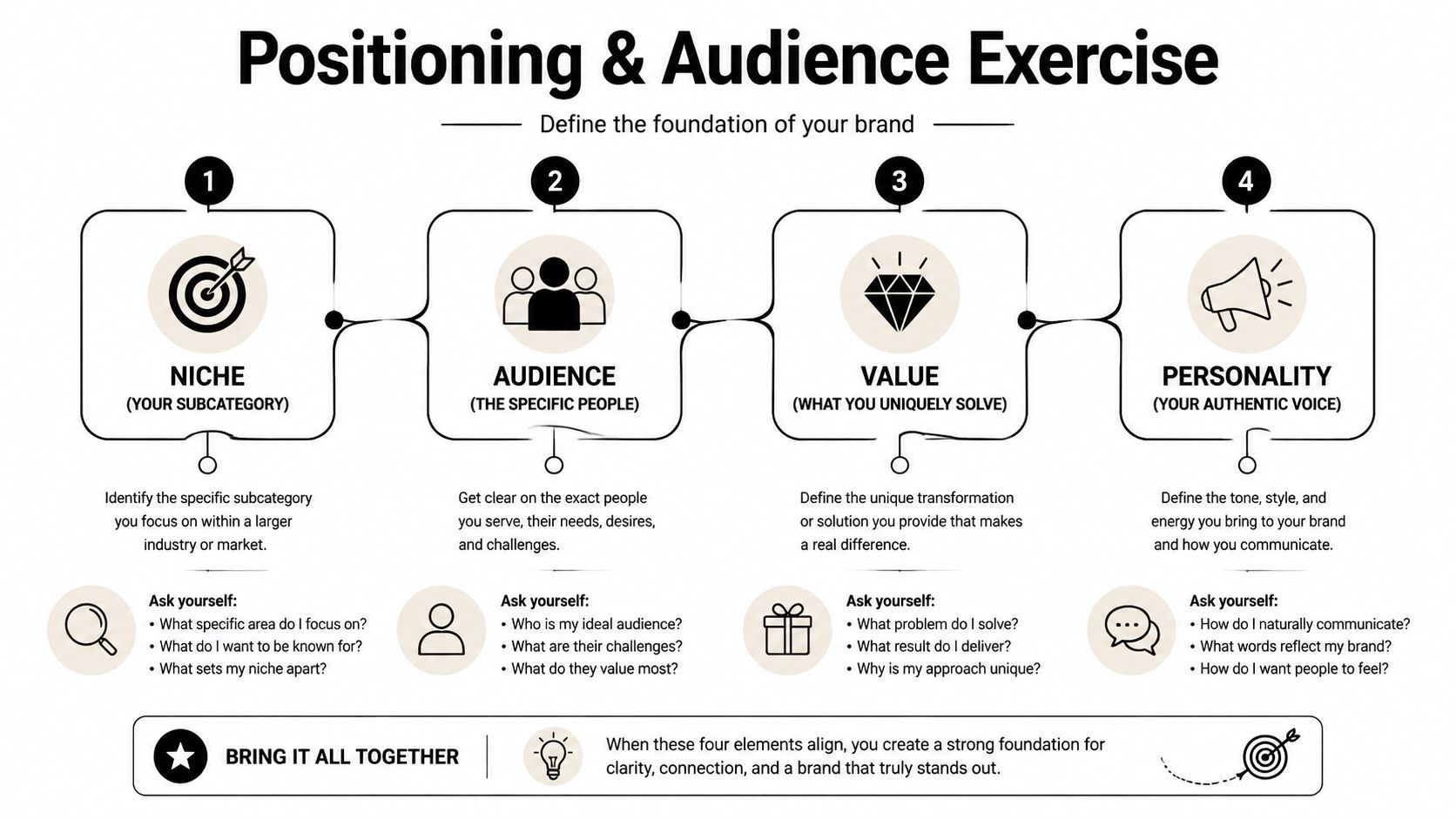
Don't open a blank composer until you can answer four questions. Most weak founder accounts skip this work, then compensate with more posting. More output won't fix an unclear promise.
Choose the field you want to own
Start with your niche, the narrow subcategory where you want people to associate your name. “SaaS” is not a niche. “Developer onboarding for API products” is closer. “Bootstrapped growth” is broad. “Pricing and retention for founder-led B2B tools” gives readers a more useful mental label.
Then define your audience as a person with a problem, not a demographic. A technical founder might target heads of engineering at small product teams. A second-time founder might speak to first-time CEOs hiring their first leadership team. A bootstrapped operator might serve founders deciding whether to prioritize cash flow or expansion.
Your proof should be concrete and available. Use shipped products, customer conversations, hiring experience, failed experiments, operating constraints, technical expertise, or a documented body of work. Proof doesn't require grand claims. It requires a credible reason that you've earned the right to hold the view.
Finally, write your thesis, the non-obvious claim you're willing to repeat. For example:
- Technical founder: “Developer tools grow when documentation reduces uncertainty, not when teams add more features.”
- Second-time founder: “The second company's advantage is judgment, but only if the founder turns past mistakes into operating rules.”
- Bootstrapped operator: “Profitability is a product-design constraint, not merely a finance outcome.”
Compress the strategy into a usable profile
Combine the fields into one sentence:
I help [specific audience] solve [specific problem] through [your distinctive approach], based on [your proof].
Then build three content pillars. One pillar should teach your core method. One should show operating evidence, including decisions, mistakes, and tradeoffs. The third should challenge common assumptions in your category.
Your profile, pinned post, and recurring content should reinforce the same sentence. If a reader can't repeat your niche, audience, proof, and thesis after reading your profile and a few posts, the positioning isn't ready.
Build Signature Content Formats That Compound
Founders waste time by inventing a new content shape every morning. Recognition grows faster when readers can identify your format before they finish the first line.
Use three formats. Each one should express the same thesis from a different angle, so repetition strengthens association rather than creating boredom.
Format one is the operating lesson
Open with a specific lesson from building, selling, hiring, or shipping. Avoid abstract openings such as “Leadership is hard.” Use a tension: “We thought more product choices would improve activation. They made the first session harder to understand.”
The body should explain the initial assumption, the observed problem, the decision you made, and the rule you now use. Close with a quotable takeaway, such as “Reduce the first decision before adding the next feature.” Your recognition cue might be a consistent label like “Operating lesson” or a distinctive final line.
Format two is the teardown
Choose a public artifact, such as a launch post, pricing page, onboarding flow, hiring loop, or investor update. Show the reader exactly what you're inspecting. Then break it into parts, identify what works, name the friction, and propose a better alternative.
The closing line should tell readers what principle they can reuse. A teardown earns authority because it demonstrates judgment in public. It also gives you a repeatable source of topics without turning your feed into personal diary content.
Format three is the falsifiable take
State a clear prediction or disagreement tied to your thesis. “Most early-stage teams shouldn't optimize posting frequency. They should optimize the reason a reader follows after visiting the profile.” Then give the conditions behind the claim and identify what would prove you wrong.
| Format | Hook Structure | Body Template | Recognition Cue |
|---|---|---|---|
| Operating lesson | Specific decision and unexpected result | Assumption, problem, decision, operating rule | Repeatable lesson label and quotable close |
| Teardown | Public artifact plus a sharp evaluation | What works, what breaks, how to improve it | Consistent breakdown structure |
| Falsifiable take | Contrarian claim with a clear prediction | Reasoning, conditions, disconfirming evidence | Distinctive thesis language |
Limit yourself to these formats for a sustained publishing cycle. The constraint reduces creative drag, makes quality easier to judge, and helps the audience remember your contribution. Rotate them across the week rather than publishing the same structure repeatedly. Recognition compounds when the content changes but the underlying shape stays familiar.
Set a Publishing Cadence and Reply Strategy
A sustainable cadence beats a heroic burst followed by silence. Start with three original posts per week, then stagger distribution between X and Threads so you're adapting the idea to each platform instead of dumping identical content everywhere at once.
Use audience behavior to choose timing. Your calendar isn't the relevant input, your readers' active periods are. Review platform analytics, identify when the people you want to reach are present, and reserve your strongest threads for the windows that consistently produce meaningful replies. Put your clearest educational or contrarian posts early in the workweek, especially on Tuesdays and Thursdays if those days match your audience's behavior.
Build a reply borrowing system
Replies are not a networking formality. They're a distribution surface.
Create a list of ten target accounts that publish about adjacent problems. They should attract the readers you want, even if they aren't direct competitors. Check those accounts soon after they publish and contribute while the conversation is still active. A useful reply adds one of three things:
- A data point: a relevant observation from your operating experience.
- A counterpoint: a limitation or opposing condition that improves the original argument.
- A clarifying frame: a sharper distinction that helps readers apply the idea.
“Great post” adds no reason to visit your profile. A concise example, disagreement, or extension can.
Reserve Fridays for lighter engagement and use the weekend to draft the following queue. Set a daily twenty-minute reply block, then stop when the block ends. The cap protects your attention and forces you to choose conversations with real audience fit.
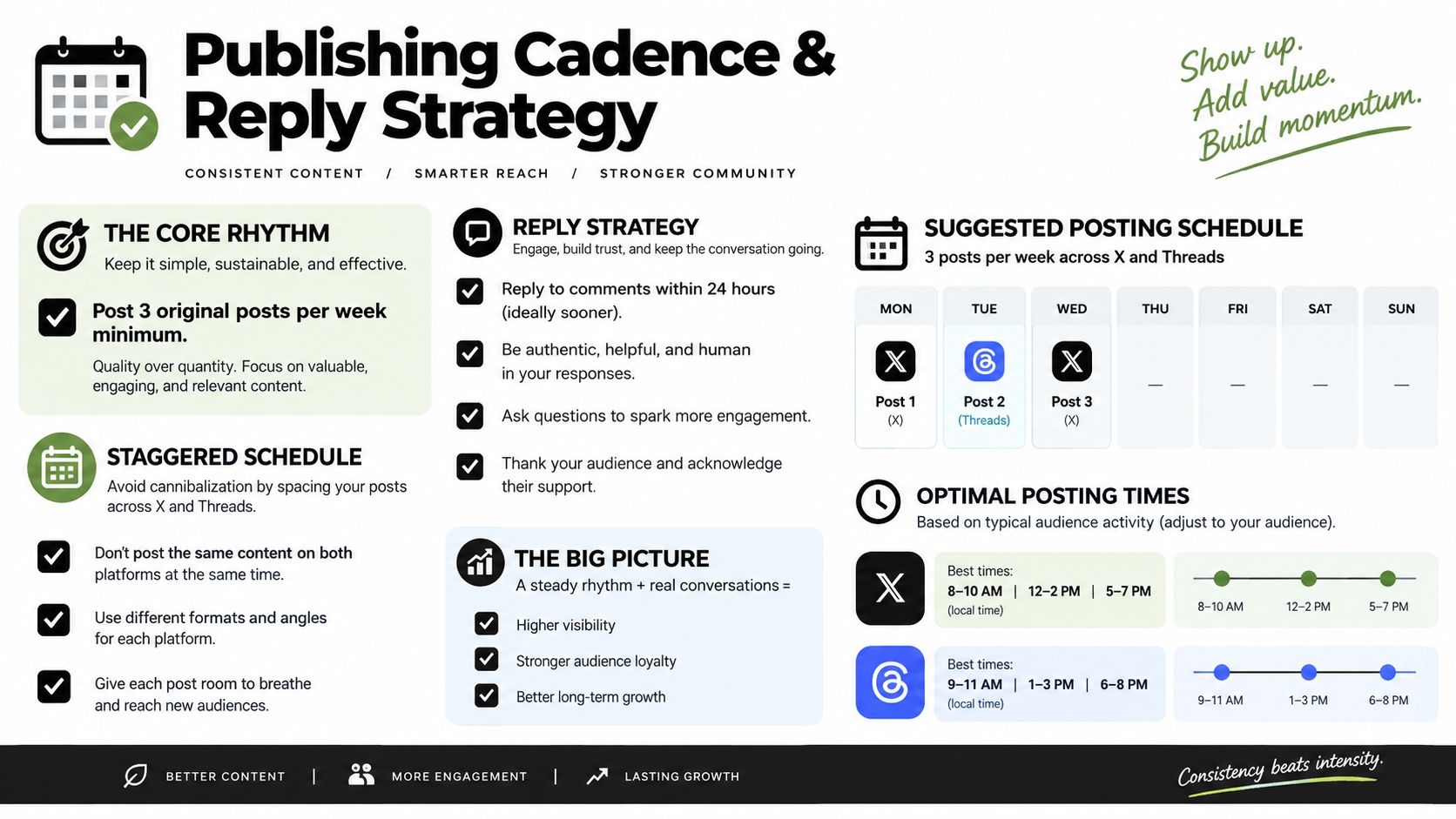
Use this guide to decide when to post as an input, not as a substitute for account-specific observation. Timing can improve the chance of an initial response, but the post still needs a strong reason to read, reply, or follow.
A reply should make the original conversation more useful, not merely make your name more visible.
Track Follow Conversion Instead of Vanity Numbers
Likes and impressions are easy to celebrate because platforms display them prominently. They don't tell you whether the right people understood your position or chose to hear from you again.
The useful metrics sit closer to intent:
- Profile visits: whether the post created enough curiosity to inspect the account.
- Follows per post: whether the profile promised valuable future content.
- Repeat profile visits: whether the account remained relevant after the first encounter.
- Link clicks: whether attention moved toward an owned destination.
- Save and share activity: whether readers considered the idea useful enough to keep or pass on.
- Reply-to-follow behavior: whether conversation participants became continuing audience members.
Diagnose the path from post to follower
Give every post a clear profile reason. A reader should know what they'll find when they click your name. Your bio, pinned post, and recent content must confirm the promise made by the post.
A practical working measure is follow conversion, calculated as profile visits divided by impressions. Use one to three percent as a working baseline, not a universal law, as summarized in industry guidance on personal branding statistics. A post below that range may have weak positioning, a mismatched profile, or a hook that attracts broad curiosity without qualified interest. A post above it deserves inspection, even if the total reach is modest.
| Metric | What It Measures | Conversion Signal |
|---|---|---|
| Impressions | Distribution | Weak by itself |
| Profile visits | Curiosity about the founder | Stronger intent |
| Follows per post | Profile promise | Direct audience growth |
| Repeat visits | Ongoing relevance | Retention signal |
| Link clicks | Movement to owned media | Deeper intent |
| Reply depth | Conversation quality | Trust and audience fit |
Use tagged links in your bio when you send readers to a newsletter, product page, or waitlist. Compare weekly follower changes with the posts and reply campaigns that preceded them. Watch how long visitors stay with your pinned material, which posts earn saves and shares, and what proportion of visitors follow in the same session.
When reach falls, don't immediately publish more. Review the causes of dropped views, then separate a distribution problem from a conversion problem. The remedy for weak distribution may be format or timing. The remedy for weak conversion is usually positioning, profile clarity, or a missing reason to return.
Use Yubook to Iterate on Every Draft
A founder content system improves when it records predictions, outcomes, and decisions. Yubook is designed for that loop, but the operating principle matters even if you use another analytics workflow: judge the draft before publication, measure the result afterward, and turn the gap into a new instruction.
Start with draft signal analysis. Review each hook for specificity, emotional resonance, and contrarian framing. If the opening could belong to any founder in your category, rewrite it. If the claim has no consequence, sharpen the tension. If the post makes a strong assertion without an operating example, add the evidence or reduce the certainty.

Forecast ranges help you make better scheduling decisions. A draft with an uncertain outcome doesn't need deletion. It may belong in a lower-stakes slot where you can test the idea without using your strongest publishing window. A draft with a clear audience fit and stronger predicted response can receive the better slot, provided you still treat the forecast as a range rather than a promise.
Turn replies into a second content queue
After publication, review which replies attract attention and thoughtful responses. Route the strongest ones into your reply queue, then develop them into future posts, teardowns, or predictions. A good reply often contains the seed of a better standalone argument because it responds to a real objection in the audience's language.
The workflow should remain transparent. Public platform signals can inform a forecast, but they aren't an official platform score. Actual outcomes remain the authority.
Use Yubook to connect draft analysis, scheduling, reply suggestions, audience growth analytics, and performance replay in one workflow. On Sunday, compare predicted and actual results across the week. Identify posts that exceeded the upper forecast band, posts that fell below the lower band, and formats that drove profile visits rather than merely impressions.
Then write next week's prompts from those findings. “Create another post” is a poor prompt. “Write an operating lesson about reducing onboarding choices, using a counterintuitive result and a one-line rule” gives the system something it can improve.
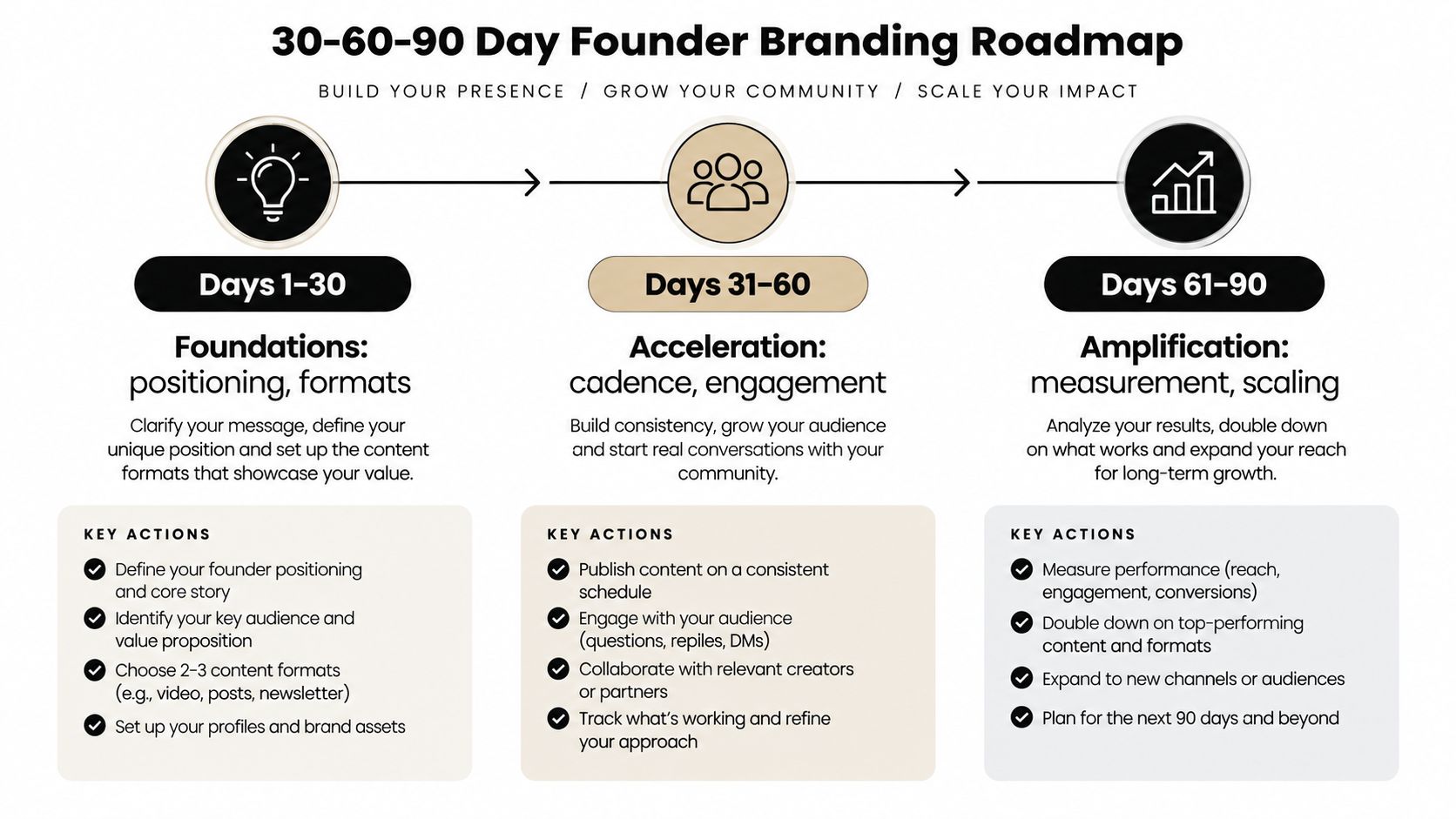
Your 30 60 90 Day Founder Branding Roadmap
A ninety-day plan should produce learning, not just a large archive of posts. Treat each phase as a test of the system's weakest link.
Days 1 to 30 build the foundation
Finalize the one-line positioning statement, define the audience, and inventory your proof. Draft two signature formats and publish them in low-stakes conditions. Start with three posts per week on X and one on Threads, then record profile visits, follows per post, and reply-to-follow behavior as your baseline.
Your checkpoint is clarity. Can the intended audience describe what you're known for? Are replies coming from people with a genuine connection to the problem? If the answer is no, improve the position before increasing output.
Days 31 to 60 create compounding behavior
Add the third signature format and raise the cadence to five posts per week only if quality remains stable. Run two cross-account reply campaigns per week, selecting adjacent accounts where your contribution can add a useful point rather than compete for attention.
Replay performance and retire formats that attract impressions without profile visits or follows. Keep a format when it produces the right conversations, even if it isn't your broadest performer. Your checkpoint is follow velocity, profile visit rate, and reply quality, not the number of drafts shipped.
Days 61 to 90 optimize conversion
Test different hooks and calls to action. Change one meaningful variable at a time, such as the opening claim, proof placement, or profile invitation. Remove formats that repeatedly miss your follow-conversion threshold, then expand the strongest format into more examples, teardowns, and replies.
Schedule a weekly 45-minute review using draft signal analysis and forecast ranges. Compare predicted performance with actual outcomes, inspect the posts that changed profile behavior, and convert the findings into next week's prompts. Your founder brand is ready to scale when the system produces recognizable content, qualified conversations, and repeatable follower conversion without requiring daily improvisation.
Yubook helps founders and creator-led teams analyze drafts, forecast likely reach, publish across X and Threads, and connect profile visits with follower conversion. Visit Yubook to turn founder branding from an improvised posting habit into a measured content system.