10 Social Publishing Tool Options for X and Threads
Compare 10 social publishing tool options for drafting, cross-posting, replies, analytics, team workflows, and sustainable growth on X and Threads.
Upkeep · 2026-08-25 · 55 min
The tool with the longest feature list isn't automatically the best social publishing tool. A calendar can make posting easier, but it won't tell you whether a profile visit became a follow, whether a reply introduced you to the right audience, or whether a successful post taught you anything useful for the next one.
A stronger comparison follows the complete X and Threads publishing loop: drafting, publishing to both networks, managing replies, measuring outcomes, and turning those measurements into better decisions. That matters because the average social media user now operates across 6.5 platforms each month and spends about 18 hours and 36 minutes per week on social media, according to Forbes Advisor's social media statistics. Cross-platform distribution is no longer a side task, but copying the same post everywhere isn't a strategy either.
Sustainable growth deserves equal billing with reach. Follow-for-follow tactics can inflate a visible number while weakening audience quality, and X warns that free-follower apps can trigger spammy auto-posts, aggressive follows, fake followers, security problems, or suspension risks in its guidance on free follower applications. The best choice depends on which part of your workflow needs improvement, and whether the tool helps you build an audience that returns, responds, and converts.
Table of Contents
- 1. Yubook
- 2. Buffer
- 3. Hootsuite
- 4. Sprout Social
- 5. Metricool
- 6. SocialPilot
- 7. Publer
- 8. Vista Social
- 9. Agorapulse
- 10. Typefully
- Top 10 Social Publishing Tools Comparison
- Choose the Workflow You Will Actually Measure
1. Yubook
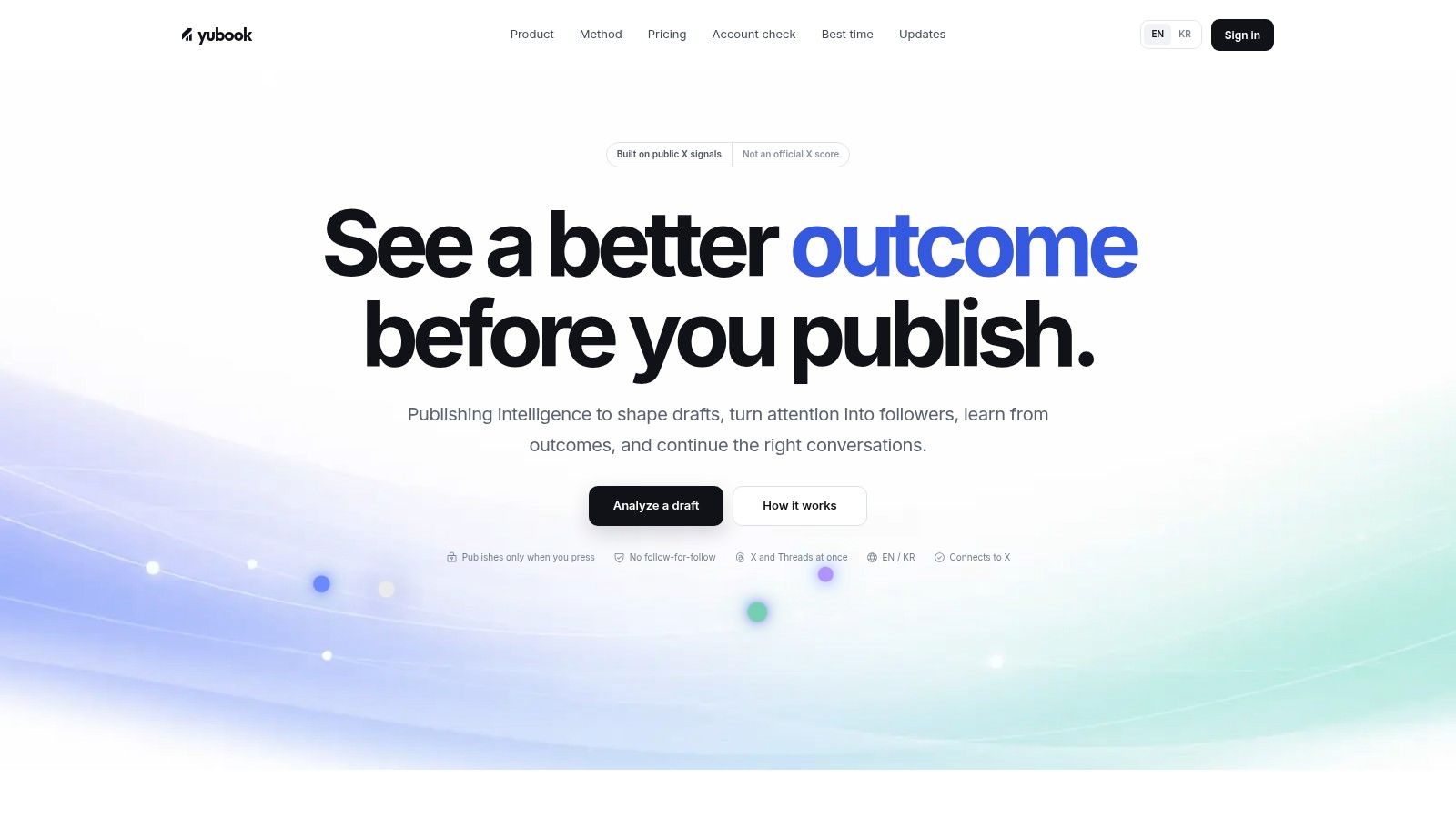
Yubook is the strongest fit when your bottleneck isn't scheduling, but deciding what deserves to be published and what the attention means afterward. Its publishing-intelligence workspace is built around X and Threads, with a browser-based draft studio that keeps what you type on your device. Before publication, it analyzes a draft against public X signals and returns a probability-range forecast for likely reach and engagement, with a signal breakdown rather than a mysterious score.
That distinction matters. Yubook doesn't claim to reproduce an official platform ranking score. It keeps versioned public signal weights separate from your measured account outcomes, so you can see where a forecast came from and whether your actual performance matched it. AI-assisted rewrites and reply suggestions use those public signal weights, while account-specific pattern memory adds timing, spacing, and calibration guidance based on your own history.
Where Yubook changes the growth question
Yubook publishes one draft to X and Threads, measures both platforms, and provides a performance replay from the first 72 hours through all time. That creates a feedback loop other schedulers often leave to spreadsheets: predicted results, actual results, profile visits, follows, repeat visits, and the next experiment.
Its reply-target queue ranks relevant opportunities where you can borrow readers from another creator's audience. The approach deliberately avoids follow-for-follow lists and trading mechanics. That is a more defensible growth model than chasing raw follower totals, especially because peer-reviewed Instagram research found that follower count and content volume were negatively associated with follower engagement, while followee count was positively associated with engagement in the studied influencer data (Journal of Retailing and Consumer Services study).
Yubook also connects cookieless visit counting with profile-visit-to-follow conversion diagnostics and a seven-day follower-growth sprint built around staged experiments. Its limitation is equally important: forecasts are probabilistic, based on public X signals, and can't guarantee outcomes. It also focuses on X and Threads, so a creator managing many networks may need a broader scheduler alongside it.
Visit Yubook's pricing page to compare the one-week trial at $9.90 per week with the recommended yearly plan at $249 per year, with the same features on both plans.
2. Buffer
Buffer remains a practical choice when the main problem is getting X and Threads posts drafted, queued, and published without operational drag. Its clean calendar, queueing system, mobile app, and per-channel billing suit solo creators and small teams that don't need a complex command center.
The important workflow trade-off is scope. Buffer supports Threads through Meta's API and continues to support X, giving users a straightforward way to adapt a post for both networks rather than maintain two separate calendars. It also offers basic analytics across major networks, but its value is strongest in execution, not in explaining why a post converted profile curiosity into a follow.
Best for simple cross-posting
Buffer's per-channel model can keep costs aligned with the profiles you use. That makes it easier to start with X and Threads, then add another channel only when the workflow justifies it. The clean interface also reduces the learning burden for creators who want to spend their time writing rather than configuring automation.
The limitation appears once a team needs deeper review and learning. Advanced analytics and collaboration sit higher in the product structure, and bulk publishing caps can be lower than those of agency-focused competitors. Buffer can tell you what was published and provide useful performance views, but teams seeking forecast-versus-actual analysis or profile-visit conversion diagnostics will need another method.
Workflow fit: Choose Buffer when consistency and low-friction scheduling matter more than pre-publication intelligence.
Explore Buffer's publishing and analytics tools if you want a simple operating layer for X, Threads, and other major networks.
3. Hootsuite
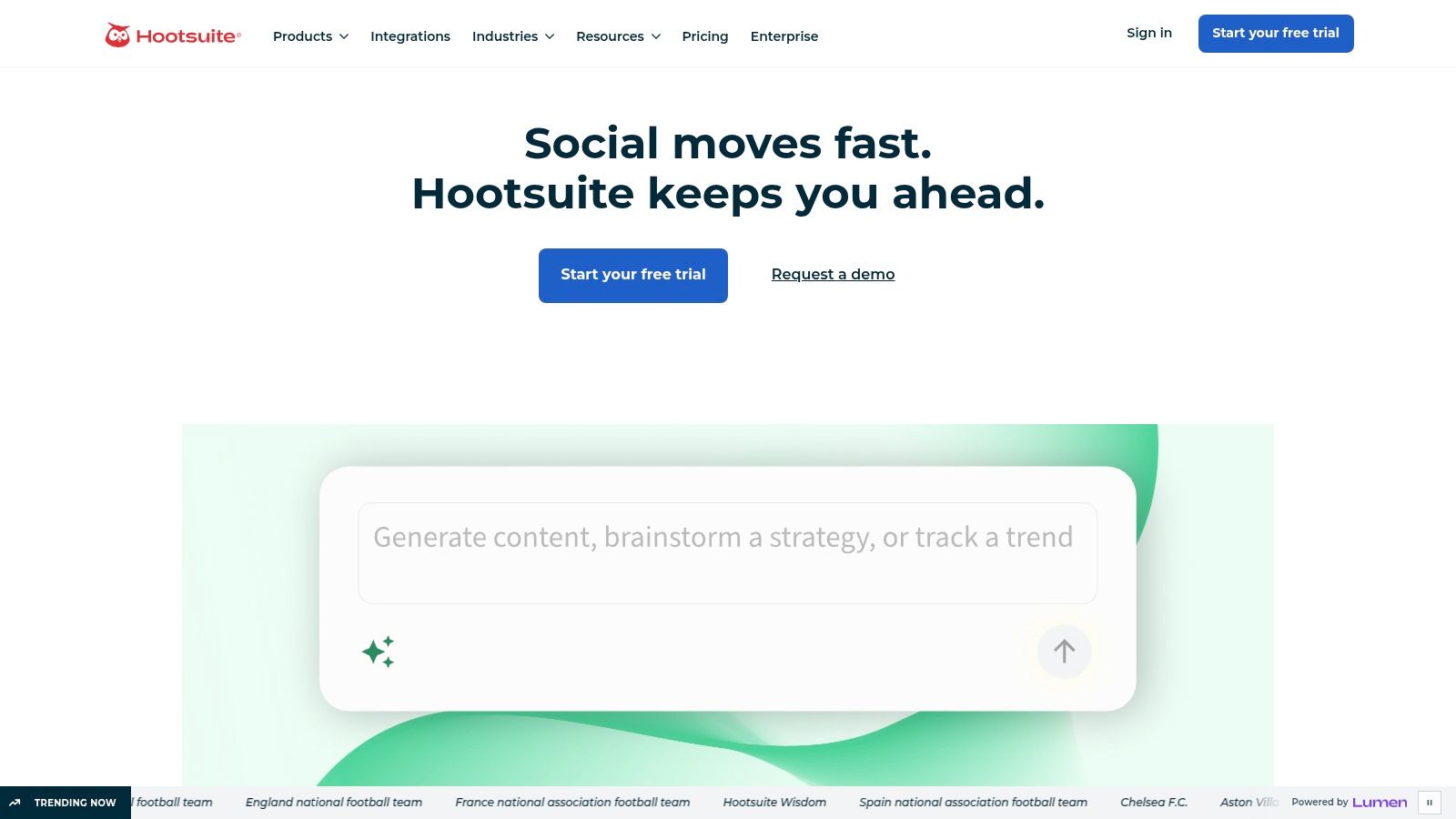
Hootsuite earns its place when publishing is only one part of a wider team operation. It combines Threads publishing and analytics with a unified inbox, multi-network calendars, content approvals, and broad coverage across X, Instagram, LinkedIn, TikTok, and other networks. That makes it better suited to organizations where replies, approvals, and reporting must happen in one controlled environment.
A community manager can work from public and private messages across major networks, while editors and stakeholders review content before it goes live. Publishing tools now face a response-management requirement, not only a scheduling requirement. HubSpot's 2026 report found that 73% of consumers say they'll switch to a competitor if a brand doesn't respond on social media, making response workflows a business concern rather than a convenience (HubSpot's 2026 Social Media Marketing Report).
Strong governance, heavier operation
Hootsuite's broad coverage is its advantage over focused X-and-Threads products. Teams managing several brands or networks can centralize approvals and engagement instead of asking staff to jump between native applications. Its listening and reporting capabilities also make it more useful when brand reputation and stakeholder reporting shape the workflow.
The cost is complexity. Solo users may find the feature set overwhelming, and per-seat pricing can escalate as more people need access. Hootsuite also doesn't solve the sustainable-growth question. It can help a team respond faster and report more consistently, but users still need to define whether success means conversation quality, referral traffic, follower conversion, or another outcome.
Review Hootsuite's unified social management platform if your X and Threads workflow sits inside a broader approval and inbox operation.
4. Sprout Social
Sprout Social is designed for organizations that need publishing, engagement, listening, analytics, and governance to operate as one system. Its Threads scheduling and analytics sit alongside shared calendars, approval flows, enterprise integrations, and reporting designed for cross-functional teams.
That makes Sprout a reporting-led choice rather than a creator-first writing environment. A social manager can schedule content, route work through approvals, monitor conversations, and prepare reports for stakeholders without stitching together separate systems. The platform's ecosystem is valuable when marketing, customer care, communications, and leadership all need visibility into the same social operation.
Reporting depth has a cost
Sprout's strongest use case is an organization that already treats social data as an input to decisions. Advanced analytics and optional listening modules can help teams examine content performance and audience response beyond a basic publishing calendar. That aligns with KPI research identifying interaction rate, reach, clicks, comment sentiment, target-group fit, and post quality as meaningful measures, while follower count appears much less often as a central KPI (research on social media KPIs).
The trade-off is economic and operational. Per-user pricing can become expensive at scale, and the platform is overbuilt for a solo creator who mainly needs to write, publish, and inspect a small set of outcomes. Sprout can support sustainable growth measurement, but it won't automatically prioritize the audience-quality signals that a creator may need to define manually.
See Sprout Social's publishing, engagement, and reporting platform if governance and stakeholder reporting dominate your X-and-Threads workflow.
5. Metricool
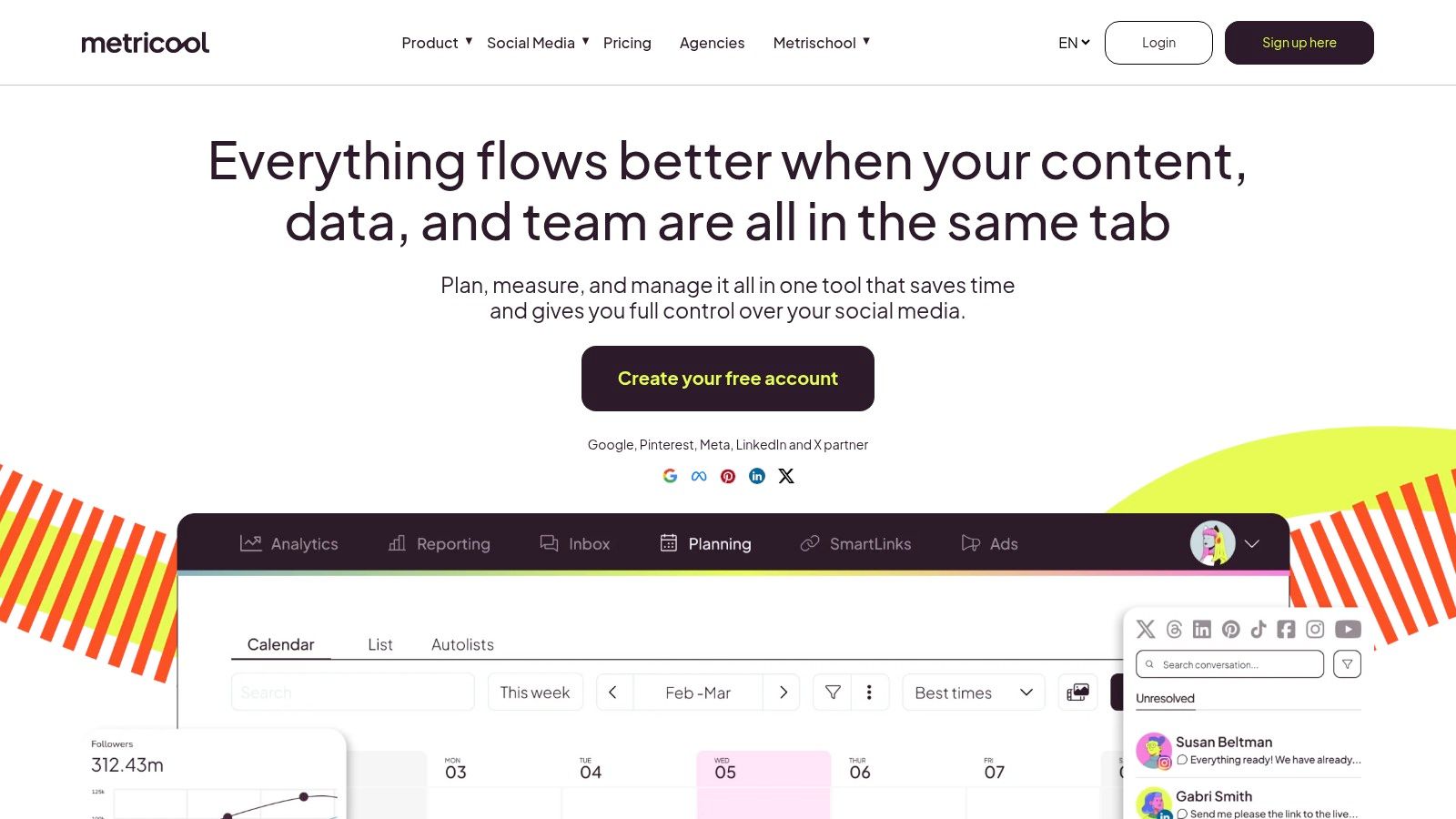
Metricool is the strongest option for creators, freelancers, and small teams that make decisions from analytics but still want broad publishing coverage. It supports Threads scheduling and analytics, including long multi-post threads, while also offering competitive analytics, downloadable reports, recurring scheduling, evergreen management, and coverage across major channels.
Its workflow starts after publication more than before it. Metricool helps you inspect what happened, compare content, and present results clearly. That makes it useful for teams that already have a reliable writing process and need stronger evidence for deciding what to repeat, adapt, or retire.
A better reporting layer for lean teams
The straightforward interface keeps the tool approachable, while bulk management and recurring scheduling reduce repetitive execution. Freelancers can also use report downloads to turn platform activity into client-facing analysis without adopting a heavyweight enterprise suite.
Metricool's limitation is the boundary between measurement and interpretation. It can show performance patterns, but it isn't primarily designed to forecast a draft's likely reach or connect profile visits to follow conversion as a dedicated growth experiment. Fair-use limits may also apply to features described as unlimited, and collaboration ceilings can appear on lower tiers.
That distinction matters because Threads and X don't necessarily reward the same outcome. Buffer's analysis of 10.2 million posts found a 6.25% median engagement rate for Threads compared with 3.6% for X, while noting that X still produced higher average engagements per post. Those figures come from Buffer's Threads versus Twitter analysis, and they illustrate why a reporting tool should help you separate median engagement from the business action you value.
Use Yubook's best-time publishing analysis when you want to add a forecast-and-learning layer to a Metricool-centered reporting workflow.
Explore Metricool if analytics depth and report delivery are more important than explainable pre-publish forecasting.
6. SocialPilot
SocialPilot fits agencies and growing teams that need to publish across many profiles without paying for a premium enterprise suite. It supports X and Threads, offers high-limit bulk scheduling through CSV imports, and provides team collaboration, approvals, and white-label reporting on higher tiers.
The central advantage is throughput. An agency can prepare large batches, assign review responsibilities, and deliver branded reports across client accounts. Broad network support also reduces the need to combine separate scheduling tools when a client publishes on X, Threads, TikTok, YouTube, LinkedIn, and other channels.
Efficient at scale, lighter on intelligence
SocialPilot's price-to-capabilities balance makes sense when the agency's problem is operational volume. Its calendar and bulk workflows can reduce repetitive publishing work, while team controls help keep client content from moving directly from draft to publication without review.
The limitation is analytical depth. Compared with top-tier suites, SocialPilot offers fewer deep listening and competitive-intelligence features. Its interface polish and mobile parity can also lag more expensive tools, which may matter when clients expect a refined review experience.
SocialPilot is not designed around a forecast of whether a post will create durable audience growth. You can use its reporting to inspect engagement and campaign results, but you'll need a separate measurement convention for profile visits, follow conversion, and repeat visitors. That makes it a strong production system for agencies, but not necessarily the best learning system for a founder-led account.
Visit SocialPilot's agency publishing platform if bulk scheduling, client approvals, and white-label reporting are your primary constraints.

7. Publer
Publer appeals to creators who want to add accounts and capabilities incrementally. Its granular pricing by social account makes the operating model easy to understand, while support for Threads posts, carousels, and long threads gives users more than a basic single-post queue.
The product also includes recycling and evergreen posting, link-in-bio functionality, design integrations, suggested hashtags, and best-time guidance. Those automations help a creator maintain a regular publishing rhythm without building a more elaborate content-operations system.
Flexible expansion, basic measurement
Publer's à-la-carte approach works well when your needs grow one account at a time. A creator can start with a narrow setup, add another profile when the audience or client workload expands, and avoid paying for a broad platform footprint immediately.
There are practical limits. X access is restricted on the free plan and requires a paid plan, while the interface and reporting are simpler than enterprise alternatives. Recycling can also create a risk if users treat evergreen content as a substitute for fresh conversation. X and Threads audiences respond to context, timing, and replies, so repeated publishing should support a learning process rather than just fill the queue.
Publer is best when scheduling mechanics are the immediate problem. It won't provide Yubook's explainable probability ranges, reply-target ranking, or prediction-versus-actual replay, so teams focused on sustainable follower conversion should supplement its basic reports with account-level diagnostics.
Compare Publer's account-based publishing options if transparent expansion and evergreen automation matter more than deep conversion analysis.

8. Vista Social
Vista Social is a modern choice for agencies and multi-user teams that want publishing, engagement, reporting, approvals, and integrations in a single workspace. Its Threads support covers planning, scheduling, engagement, and reporting, while the open API gives teams a route into wider operational systems.
The platform's appeal comes from speed of adaptation. Vista Social has a growing integrations catalog and tends to add newer networks and features quickly, including Bluesky and link-in-bio capabilities. That can matter for teams that don't want their publishing workflow to depend entirely on the release cycle of legacy incumbents.
Good team value, smaller ecosystem
Competitive pricing for multi-profile and multi-user scenarios makes Vista Social a credible middle ground between lightweight schedulers and enterprise suites. Approval workflows and report templates help agencies coordinate clients without forcing every stakeholder into the full production process.
The compromise is predictability. Long-time buyers have reported occasional plan or feature changes, and the ecosystem remains smaller than those of established enterprise platforms. Teams should verify the exact features and integrations included in the plan they intend to use rather than assume the product's broad positioning covers every workflow.
Vista Social can manage the loop from publishing through engagement and reporting, but it doesn't make sustainable growth its central analytical concept. Teams still need to decide how they distinguish an attractive engagement rate from profile visits, qualified follows, and repeat attention. That gap is manageable for an agency with its own reporting discipline, but it matters for creators looking for guided experimentation.
See Vista Social's multi-profile publishing and collaboration tools if fast onboarding and team workflow integrations outweigh a larger legacy ecosystem.
9. Agorapulse
Agorapulse is the clearest choice when reply management is the operational bottleneck. It supports direct creation and publication of X and Threads threads, provides a unified inbox for both networks and other major platforms, and adds assignments, approvals, Canva integration, first-comment scheduling, and bulk CSV publishing on higher tiers.
That configuration changes the center of gravity from calendar management to community management. A team can assign a reply, track its status, and keep moderation work connected to the same publishing environment. For brands where unanswered comments create customer-service risk, this is more valuable than another batch of scheduling automation.
Strong inbox, per-user economics
Agorapulse's reporting and collaboration tools make it suitable for brands that need to connect publishing with moderation. Native thread creation is also useful for X and Threads because a multi-post argument is not the same thing as a set of unrelated scheduled updates.
The limitation is pricing structure. Predominantly per-user pricing can add up as teams expand, and advanced features are reserved for higher tiers. Solo creators may therefore pay for governance they don't need, while larger teams should calculate access requirements before committing.
Agorapulse also doesn't automatically answer whether replies generated durable audience growth. It can help you manage conversations efficiently, but you'll need a separate convention for measuring whether those conversations led to profile visits, follows, or repeat engagement. Its strength is keeping people responsive and organized, not forecasting which draft deserves attention before publication.
Explore Agorapulse's unified inbox and publishing workflows if community moderation is more important than pre-publish scoring.
10. Typefully
Typefully is the most focused writing environment in this comparison. It began with X threads and now publishes to X, Threads, LinkedIn, Bluesky, Mastodon, and other networks, while keeping the interface fast and creator-oriented.
Its native thread composer is the main reason to choose it. Writers can shape a long argument, refine individual posts, and publish across text-based networks without adopting the heavier workflow of an enterprise social suite. Support for newer X formats, including Articles, also keeps the drafting experience close to the platform's evolving publishing formats.
Excellent drafting, lighter business analysis
Typefully works best when writing quality is the constraint. The lower learning curve suits solo creators, newsletter writers, founders, and product builders who need a clean place to develop ideas and schedule them without managing multiple brands or approval chains.
The trade-off is measurement depth. Typefully offers lightweight analytics, but it is lighter on multi-brand governance, inbox management, and deep reporting than Hootsuite, Sprout Social, or Agorapulse. Pricing by social set can also become less attractive when one user manages many brands.
Typefully helps you publish a better thread. It doesn't necessarily show whether that thread turned attention into durable audience growth, and it doesn't replace a structured experiment around profile visits, follower conversion, or repeat visits. Writers who want focused drafting can pair it with a separate analytics system, while those who want forecasted outcomes and reply discovery should consider a more intelligence-led workflow.
Use Yubook's X draft check when you want to evaluate a Typefully draft against explainable public signals before publication.
Try Typefully's creator-first writing workflow if drafting and refining X and Threads posts is the part of the loop that slows you down.
Top 10 Social Publishing Tools Comparison
| Product | Core features | Unique selling points | Best for | Pricing / Notes |
|---|---|---|---|---|
| Yubook (Recommended) | Explainable pre-publish forecast; browser-based draft studio; AI rewrites; cross-post X+Threads; reply-target queue; growth analytics | Signal-aware, versioned public signals; privacy-forward (in‑browser typing, cookieless); performance replay; 7-day follower sprints | Creators & small teams publishing on X + Threads who want explainable growth and learning | $9.90/week trial or $249/year; Paddle merchant |
| Buffer | Scheduling, calendar, queueing, basic analytics, mobile app | Low-friction UI; per-channel billing for cost control | Solo creators & small teams needing simple cross-posting | Per-channel pricing; affordable entry tiers |
| Hootsuite | Scheduling, unified inbox, approvals, multi-network calendar | Robust team workflows; broad network coverage | Teams requiring unified inbox, approvals, multi-network ops | Per-seat pricing; can escalate for larger teams |
| Sprout Social | Publishing, listening, advanced analytics, approval flows | Deep reporting & enterprise integrations | Enterprises and orgs needing governance & deep analytics | Enterprise-tier pricing; per-user costs high |
| Metricool | Threads scheduling, competitive analytics, recurring scheduling | Strong analytics for the price; report downloads | Freelancers and SMBs seeking data depth on a budget | Competitive, lower-cost plans |
| SocialPilot | Threads publishing, high-limit bulk scheduling, white-label reporting | Good price-to-capabilities ratio for agencies | Agencies and growing teams needing bulk and white-label | Agency-oriented pricing; high bulk limits |
| Publer | Threads (single & multi-post), recycling/evergreen, per-account add-ons | Transparent à‑la‑carte pricing; scalable per-account | Creators scaling accounts incrementally on a budget | Budget-friendly; pay‑per‑account/member add‑ons |
| Vista Social | Planning, scheduling, reporting, API, team approvals | Competitive multi-user pricing; fast platform onboarding | Multi-profile teams and agencies wanting integrations | Competitive multi-user plans; API access |
| Agorapulse | Thread creation, unified inbox, Canva integration, bulk CSV | Mature inbox and collaboration (assignments, approvals) | Brands prioritizing moderation, collaboration, and reporting | Per-user pricing; advanced features on higher tiers |
| Typefully | Native thread composer, multi-network publish, minimal drafting UI | Excellent drafting & thread-building experience | Individual creators focused on writing and threads | Per “social set” pricing; creator-focused plans |
Choose the Workflow You Will Actually Measure
The right social publishing tool depends on the failure point you can identify. If writing quality is the bottleneck, Typefully gives solo creators a focused drafting and thread-building environment, while Buffer provides a simpler route from finished draft to scheduled post. Publer adds incremental account expansion and evergreen automation, which suits creators who want control over how their publishing footprint grows.
Choose a broad suite when governance, approvals, and inbox management dominate. Hootsuite offers mature multi-network coverage and unified engagement workflows. Sprout Social is a stronger fit for organizations that need deep reporting, listening, and enterprise collaboration. Agorapulse is the more direct choice when a team must assign, moderate, and resolve conversations across X and Threads without losing them inside separate native inboxes.
An analytics-led option makes more sense when reports drive decisions. Metricool is well positioned for creators, freelancers, and small teams that want data depth and report downloads without adopting a heavier enterprise system. SocialPilot offers a practical agency balance of bulk publishing, approvals, broad network support, and white-label reporting. Vista Social is attractive for multi-user teams that value integrations and quick platform coverage, while its smaller ecosystem means buyers should verify plan details carefully.
Yubook is different because it treats publishing as a learning system rather than a queue. Its strongest use case combines explainable forecasting, reply discovery, sustainable audience growth, profile-visit-to-follow diagnostics, and prediction-versus-actual replay. That makes it the most relevant choice when the question is not “Did this post receive attention?” but, “Which publishing decision created the next useful audience action, and what should we change?”
Follower totals deserve skepticism. A peer-reviewed marketing study found that higher follower counts can signal broader reach while also cueing a weaker relationship with followers, reducing the likelihood of engagement (Journal of Marketing Research study). The practical implication is that a tool should help you measure audience quality and responsiveness, not encourage artificial growth.
Run one recurring publishing cycle across X and Threads before choosing a long-term system. Use the same content themes and review process, record drafting friction, publication reliability, reply workload, profile visits, follower conversion, and repeat visits, then compare those observations with reach and engagement. Don't commit based only on the cleanest calendar or the largest feature list. Commit to the tool that helps your team make better publishing decisions and prove why those decisions worked.
Yubook combines explainable draft forecasting, cross-posting to X and Threads, reply discovery, follower-conversion diagnostics, and prediction-versus-actual learning in one publishing-intelligence workflow. Visit Yubook to test whether its sustainable, signal-aware approach fits the publishing cycle you want to measure.