Threads Content Strategy That Actually Converts
Build a threads content strategy that grows followers, not vanity metrics. Covers pillars, formats, reply tactics, A/B tests, and measurement.
Upkeep · 2026-09-13 · 38 min
You've posted consistently on Threads for weeks. The impressions are respectable, likes arrive often enough to keep the habit alive, yet your follower count barely moves and your pipeline shows no obvious connection to the work. The problem usually isn't a lack of effort. It's that the calendar was built around how often to post, before anyone decided what each post should accomplish.
A practical Threads content strategy starts with three reader jobs: discovery, when a stranger decides you're worth following; trust, when a follower keeps returning because your content delivers on a clear promise; and conversion, when an interested reader visits your profile, follows, replies with intent, or takes a relevant off-platform action. Reach is useful, but it's a diagnostic signal, not the finish line.
Threads has expanded from 100 million sign-ups in its first five days after launch in July 2023 to 500 million monthly active users by June 16, 2026, according to CBC's reporting on the initial sign-up milestone. That audience expansion creates opportunity, but it also means a flat posting routine can produce plenty of activity without creating a memorable reason to follow.
Table of Contents
- Why Most Threads Strategies Stall Before They Start
- Choosing the Right Threads Post Format for Each Job
- Timing, Spacing, and the First Hour Window
- Reply-Led Growth Tactics That Borrow Readers
- Designing A/B Experiments You Can Actually Trust
- Measurement, Follow Conversion, and Replay Loops
- Your First-Week Threads Strategy Checklist
Why Most Threads Strategies Stall Before They Start
The most common failure starts with a reasonable ambition: post every day, stay visible, and let consistency compound. After a while, the account has a full feed but no clear relationship between a post and a business outcome. A punchy observation might earn attention, a personal update might collect replies, and a promotional link might receive almost nothing, yet all three are judged by the same likes column.
That's a planning error. Cadence is an operating constraint, not a strategy. Before choosing a schedule, assign every post one dominant job. Discovery posts should make an unfamiliar reader recognize a useful perspective. Trust posts should reward an existing follower with proof, process, or a distinctive point of view. Conversion posts should make the next action obvious without turning the feed into an advertorial stream.
Diagnose the audience you already have
Skip the elaborate persona document at first. Your existing engagement contains better evidence.
- List recent winners. Write down who replied, what they said, and which post attracted them. Note whether the post created discovery, trust, or conversion.
- Group your themes. Collapse your subject matter into four to six pillars. Each pillar should serve one dominant job and contain a claim that could stand alone in a repost or reply.
- Write an anti-pillar. State what you won't publish. This prevents unrelated announcements, generic inspiration, and low-fit commentary from weakening the account's promise.
- Apply the five-second test. Every idea should fit a pillar almost immediately. If it takes a paragraph of explanation to classify, the pillar is too broad for daily execution.
Consider a B2B founder selling a developer tool. An ICP insight pillar can serve discovery, with a claim such as, “Small engineering teams don't need more dashboards, they need fewer handoffs.” A behind-the-build pillar can serve trust by showing a product decision, trade-off, or failure. A case teardown with a clear next step can serve conversion, provided the post explains who should act and why.
The anti-pillar might be “general startup motivation.” It may attract agreement, but it doesn't strengthen the product's category, audience, or profile promise. That distinction matters because a large response from the wrong readers can leave profile visits and follows unchanged.
If you're worried that a sudden drop in visibility reflects an account problem rather than weak job alignment, use a structured Threads shadowban check before rewriting your entire content system. The check won't replace post-level diagnosis, but it can stop you from treating a distribution issue as a messaging issue.
Map pillars to reader jobs
| Pillar | Reader Job | Example Claim |
|---|---|---|
| ICP insight | Discovery | Small engineering teams lose time at handoff points, not only in coding |
| Behind the build | Trust | Removing a product feature can improve the customer experience |
| Case teardown | Conversion | A team should audit this workflow before choosing another tool |
| Practical replies | Trust and discovery | A clear explanation can travel beyond the original conversation |
Your calendar should show a deliberate mix rather than a pile of interchangeable posts. Discovery earns new attention, trust makes that attention durable, and conversion tests whether the attention has commercial or community value. If one lane dominates, the symptoms become predictable. Discovery without trust creates curiosity without retention. Trust without discovery talks mainly to the same followers. Conversion without either feels abrupt and gets ignored.
Choosing the Right Threads Post Format for Each Job
Format should follow the reader job, not personal preference. A short text post can make one sharp idea easy to repeat, while a long text post with deliberate line breaks can unpack reasoning for readers who already care. Neither format is automatically superior.
A carousel can support discovery when the first card states a specific claim and the following cards develop it. A polished single image may stop the scroll, but if the image carries no useful assertion, it gives the reader little reason to visit the profile. Quote reshares work best when your commentary adds an independent idea. Repeating “great point” borrows attention without building authority.
| Format | Best Reader Job | Common Failure | Metric to Watch |
|---|---|---|---|
| Short text post | Discovery | A clever line with no useful position | Profile taps |
| Long text with line breaks | Trust | Too much setup before the payoff | Replies and saves |
| Single image | Discovery | Visual polish without a claim | Impressions and profile taps |
| Carousel | Discovery and trust | Several vague slides instead of one argument | Shares and saves |
| Quote reshare with commentary | Trust | Commentary merely repeats the source | Qualified replies |
| Poll | Discovery | Easy votes with no follow-up insight | Replies after voting |
| Text with link | Conversion | Link appears before the value is clear | Profile visits and link actions |
For conversion, plain text often beats a generic link-in-bio card because the post can state the problem, identify the reader, and offer one next step in the same native voice. The link should complete an argument, not substitute for one. If the reader needs to leave Threads to understand why the resource matters, the post hasn't done enough work.
Use saves as a trust signal when the content is instructional, but don't treat them as universal proof. A discovery post can generate profile taps with few saves, while a trust post may be saved and produce fewer immediate follows. The correct question is whether the metric matches the job you assigned before publishing.
Timing, Spacing, and the First Hour Window
Timing is a distribution problem, not a ritual performed at a supposedly perfect hour. Start by reviewing when your own audience is active, then choose core windows that give you enough time to participate after publishing. Generic timing lists can offer a hypothesis, but your replies and audience context should decide whether that hypothesis survives.
A practical workflow is to map the activity curve, select two or three core posting windows, and leave room between posts. The Threads timing workflow should help you compare windows against your own results rather than encourage blind scheduling.
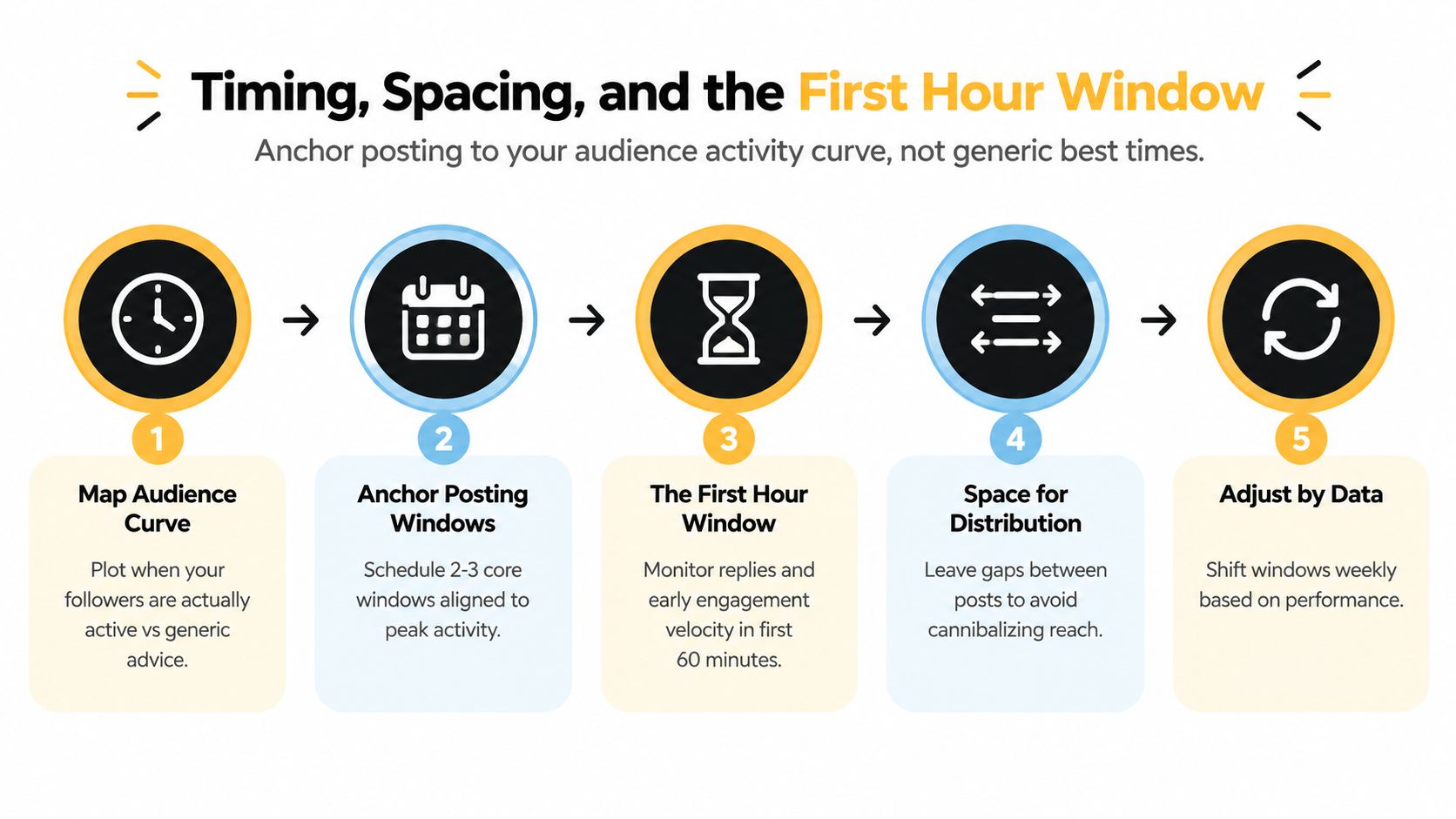
The first 60 to 90 minutes deserve active attention. One independent Threads optimization source identifies reply count and reply depth as stronger distribution signals than likes, and describes that early period as a particularly important predictor of amplification in its Threads engagement guidance. That makes the post-publication workflow part of the content itself.
A solo creator can test two to five posts per day, the range recommended by that same source, but more volume isn't automatically better. Space posts so each one has a chance to collect meaningful discussion, and reply to responses within 60 minutes when possible. Stacking posts too closely can split your attention, cannibalize replies, and make a healthy account look busy rather than conversational.
Classify a post after its first window. A dead post has little early activity and no clear reason for readers to continue the conversation. A slow starter has relevant replies arriving gradually, so it may need more time before judgment. A post that is catching fire produces deeper exchanges, profile interest, and responses that extend beyond the original prompt. Don't rescue a weak post by publishing another immediately. First identify whether the issue was the hook, the audience fit, or the follow-up.
Reply-Led Growth Tactics That Borrow Readers
A thoughtful reply can be more valuable than another original broadcast post because it enters a conversation that already has attention. Think of each relevant thread as a small room. The original author and engaged readers have already supplied context, and your reply gives them a doorway to your profile.
Choose reply targets with discipline. Start with relevance to your pillars, then consider whether the audience plausibly overlaps with yours, and finally check recency so the conversation is still alive. A large account isn't automatically a useful target. A smaller, highly relevant discussion can produce better profile curiosity than a crowded thread where every reply says the same thing.
Depth matters. Add a counterexample, explain a mechanism, share a useful distinction, or answer the unanswered part of the original post. A reply that can stand alone as a valuable post has a better chance of attracting readers who didn't see the source conversation.
Practical rule: Never extract attention without adding information, clarity, or a genuinely useful perspective.
Reciprocity doesn't mean empty compliments or forced networking. Respond to people who engage with your reply, ask a narrower follow-up question, and acknowledge the specific point they made. This creates multi-turn discussion rather than a sequence of disconnected comments.
The relevant source recommends prioritizing reply count and reply depth over raw likes, and recommends replying within the early post window. That changes the daily workflow. Instead of asking, “What's my fourth post today?” ask, “Which active conversation can I improve, and which response would make a qualified reader curious about my profile?”
The diagnostic question is simple: Did your reply create a reason for someone to continue the discussion or visit your profile, or did you comment only to be seen? If the answer is the latter, you're performing engagement, not building distribution.
Designing A/B Experiments You Can Actually Trust
Threads testing becomes unreliable when several changes arrive together. Change the hook, format, topic, and posting window in the same week, then you won't know which factor produced the result. A credible test has one variable, one audience segment, one outcome, and one observation window.
Test hooks by keeping the topic and format stable. Compare a direct claim with a question, then judge qualified replies or profile visits rather than likes alone. Test formats by keeping the central claim stable, publishing it as short text in one version and a carousel or long-form post in another. Test timing only after the content itself is reasonably consistent.
Define success before publishing. For discovery, use profile taps or follows from the post cluster. For trust, use reply depth, saves, or repeat participation. For conversion, track profile visits followed by a follow or an intent-revealing reply. The Threads engagement benchmark guidance recommends exporting the last 30 days of analytics, comparing your account's baseline with platform norms, and testing one variable for 2 to 4 weeks so you can isolate likely causality.
One benchmark source places healthy Threads engagement in the 4% to 5% range, while another reports a median of 6.25% and suggests approximately 3.6% as a keep-pace floor, all from the linked benchmark guidance. Treat those figures as context, not a promise. Your own conversion and audience quality still matter more than winning a broad comparison.
| Test Focus | Variable Changed | Success Metric | Min. Window |
|---|---|---|---|
| Hook | Opening claim or question | Qualified replies | 2 weeks |
| Format | Short text versus carousel | Profile taps | 2 weeks |
| Posting window | Activity-aligned time slot | Follows from visits | 2 weeks |
| Topic pillar | One pillar versus another | Repeat visits and follows | 2 weeks |
A spreadsheet row is enough: date, job, pillar, format, hook, window, impressions, replies, profile visits, follows, and notes. An inconclusive test is still useful if it tells you the variable didn't create a clear difference under those conditions.
Measurement, Follow Conversion, and Replay Loops
Followers are a leading indicator, not the finish line. A post can collect attention from people who never need your perspective again, while a smaller conversation can bring readers who return, reply, and follow. Your measurement system should separate those outcomes instead of compressing them into one engagement score.
Tag each post before it goes live. Discovery posts can track impressions and profile taps. Trust posts can track saves, reply depth, and repeat participation. Conversion posts can track profile visits followed by a follow within 24 hours, provided your analytics can connect those actions reliably.
The most revealing ratio is follow conversion rate, calculated as follows:
Follows from a post cluster ÷ profile visits from that cluster
Use the same attribution rule every time. If profile visits rise but follows don't, the post created curiosity without a compelling profile promise. If follows rise but repeat visits and replies remain weak, the account may be attracting people who don't fit the intended audience.
Review the numbers weekly, then replay the strongest and weakest patterns. Which pillar generated discovery? Which format produced saves from the right readers? Which reply thread sent people to the profile? Which posts earned attention but failed to create a reason to stay?
A forecasting tool can help you model a planned week before publishing, while replay analytics can compare predictions with actual results over time. Yubook offers draft signal analysis, probability-range forecasts, reply-target prioritization, audience growth analytics, and prediction-versus-actual replay for X and Threads. It's one option for teams that want to connect publishing decisions with follow conversion instead of reviewing vanity metrics in isolation.
If views fall unexpectedly, separate distribution diagnosis from content diagnosis with a Threads views troubleshooting guide. Don't rewrite every pillar until you've checked whether the change is isolated to one post, one window, or the account's broader visibility.
The loop is: tag the job, publish the claim, measure the matching outcome, replay the result, and adjust one decision. That process turns a Threads content strategy into a learning system.
Your First-Week Threads Strategy Checklist
More posting doesn't equal more growth. A tight first week should prove whether your account can connect a reader job to a pillar, a format, a reply workflow, and a measurable action.
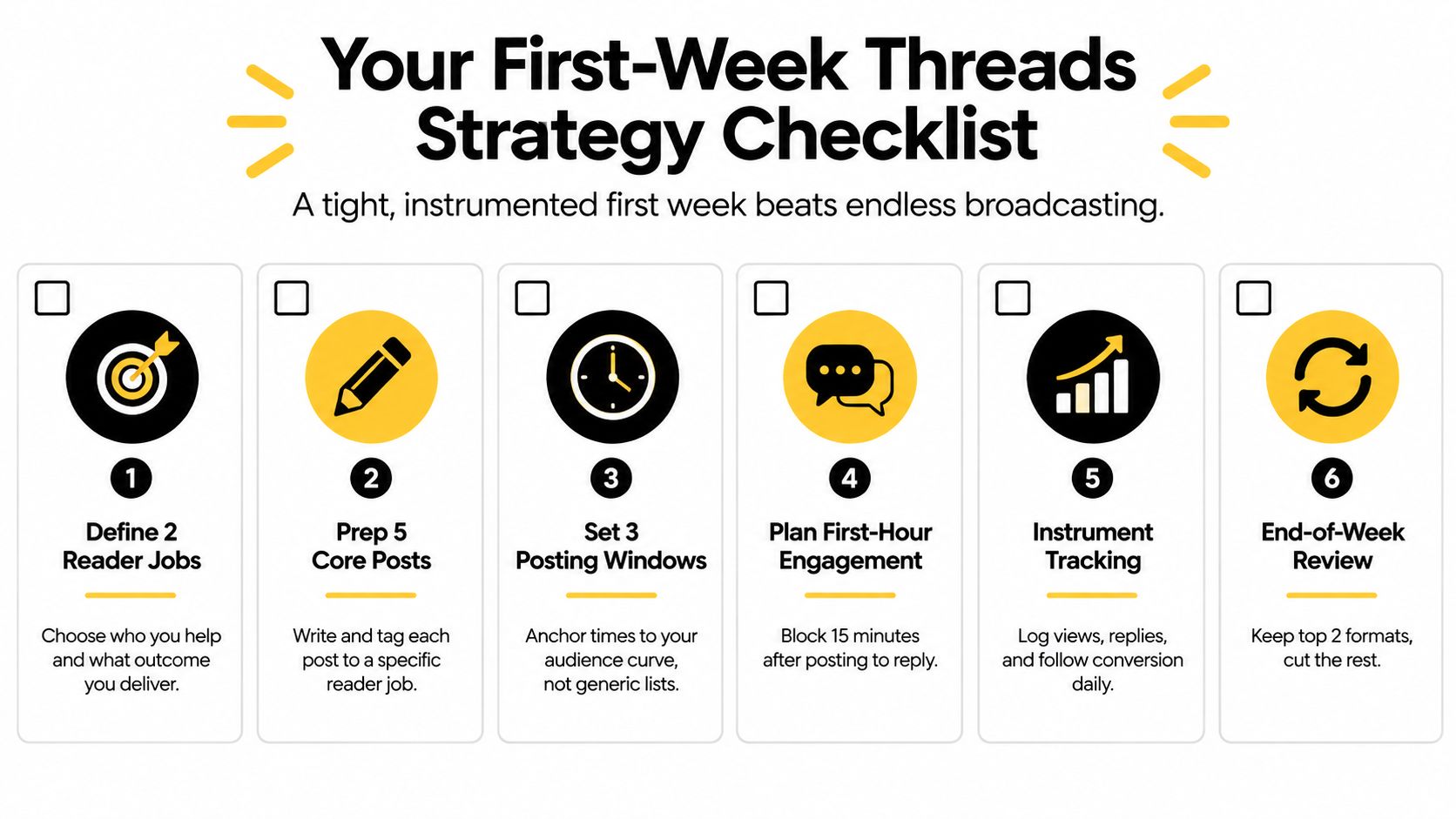
Use the week to install the loop, not to perfect your entire brand voice:
- Define the jobs. Choose the audience you help and identify whether your first priority is discovery, trust, conversion, or a deliberate combination.
- Prepare core posts. Draft posts across your pillars and label each by reader job before you schedule anything.
- Set posting windows. Use your audience activity curve and choose a sustainable cadence. The benchmark guidance supports testing 2 to 5 posts per day, but select a level you can support with real replies.
- Protect the first window. Reserve time after every post to answer replies, deepen useful discussions, and watch whether the post is slow, stalled, or accelerating.
- Run one hook test. Keep the topic and format stable while changing only the opening. Decide in advance whether qualified replies, profile taps, or follows will determine the winner.
- Log conversion daily. Record views, replies, profile visits, follows, and the job assigned to each post.
- Review the evidence. Identify the pillar carrying discovery, the format supporting trust, and the conversation producing the strongest follow intent. Keep the patterns that teach you something and cut activity that only creates noise.
Threads is still expanding quickly. It reached 400 million monthly active users in August 2025 and 500 million in June 2026, with the latter milestone arriving less than 10 months after the former, as reported by TechCrunch's coverage of the platform's growth. That environment rewards experimentation, but it also makes lazy volume harder to defend. Your advantage is knowing why a post exists and what evidence would justify repeating it.
Use Yubook to analyze Threads drafts, forecast likely reach ranges, prioritize relevant reply targets, and connect profile visits with follower conversion. Build your first-week plan around discovery, trust, and conversion, then use the prediction-versus-actual replay to decide what deserves another post.