What Is Negative Feedback and How Creators Can Use It
Learn what is negative feedback across biology, engineering, and social media, plus how creators can measure and reduce it to protect reach on X and Threads.
Upkeep · 2026-09-09 · 47 min
The advice sounds simple: “Lean into negative feedback.” For creators, that phrase can be dangerously incomplete. On X and Threads, negative feedback isn't usually a critical reply telling you what to improve. It may be a viewer dismissing a post, muting an account, scrolling away immediately, or choosing not to follow after visiting a profile.
That distinction matters. A viral reply pile-on is visible, emotional, and easy to notice. An algorithm reducing the distribution of similar posts may look like a flat impression curve with no warning attached. Both involve audience response, but only one arrives as a conversation.
The useful definition starts in engineering, moves through biology, and then returns to platform mechanics. Once you understand the loop, you can treat a draft as a testable stimulus, interpret audience reactions as measurements, and make focused changes instead of rewriting your entire publishing system.
Table of Contents
- The Misleading Way Most People Hear About Negative Feedback
- Defining Negative Feedback the Universal Way
- How Biology and Engineering Build the Same Loop
- Negative Feedback as a Platform Signal on X and Threads
- Measurable Signals Creators Should Watch
- Drafting and Mitigation Strategies That Reduce the Signal
- Three Experiments to Validate the Impact on Your Own Account
- A Shared Mental Model for the Next Draft
The Misleading Way Most People Hear About Negative Feedback
A post can attract loud criticism and still perform well. Another can receive no hostile replies while its reach stalls. That gap reveals why creators often misread negative feedback: public reaction is only one visible part of a platform's response.
In ordinary conversation, negative feedback usually arrives as language about a missed effect. A reader may call a thread confusing, a customer may reject a proposal, or a colleague may identify an unclear explanation. Because the response is stated directly, you can inspect the complaint and decide what to change.
Platform feedback is less explicit. A viewer can dismiss a post, scroll away quickly, mute the account, block the author, unfollow, report the post, or select Not interested without writing anything. Each action can provide information that affects how later posts are distributed.
Practical rule: A visible criticism is feedback you can read. A distribution change is feedback you need to diagnose.
Consider two creators covering the same topic. The first receives a large reply pile-on, while many people continue reading, sharing, and visiting the profile. The second receives almost no hostile replies, yet the impression curve stalls because viewers repeatedly dismiss the post or leave before engaging. The first situation is socially noisy. The second may affect future reach more directly.
Why the popular framing costs creators
A criticism-only definition directs attention toward comments and away from behavior. You may answer every objection while overlooking an opening line that sends uninterested readers onward. A quiet decline in reach can also look like bad luck, even though a recommendation system may be reducing distribution after repeated weak responses.
Engineering gives the term a more precise meaning. IEEE's feedback tutorial describes negative feedback as a closed-loop mechanism in which part of the output is subtracted from the reference input to create an error signal. That error guides corrective action, helping stabilize the process instead of amplifying disturbances.
The same logic gives creators a practical sequence:
- Definition: Identify the target, the measured result, and the gap between them.
- Analogy: Use biology and engineering to understand how sensors, controllers, and effectors cooperate.
- Mechanics: Translate the loop into actions that X and Threads can register.
- Practice: Match observable signals to draft-level fixes and controlled experiments.
A draft is therefore a stimulus sent into a system. Audience actions provide measurements, and distribution changes indicate how the system is responding. Negative feedback functions as system information rather than a personal verdict, signaling where a draft missed its intended audience.
Defining Negative Feedback the Universal Way
Negative feedback is a corrective signal that moves a system toward a desired condition. The system starts with a target, measures the result, finds the gap, and changes its behavior to narrow that gap.
A thermostat shows the pattern clearly. You set a preferred room temperature. A sensor measures the actual temperature, a controller compares it with the set point, and a heating or cooling unit responds. If the room becomes colder than intended, the system turns on heat. Its response opposes the deviation instead of strengthening it.
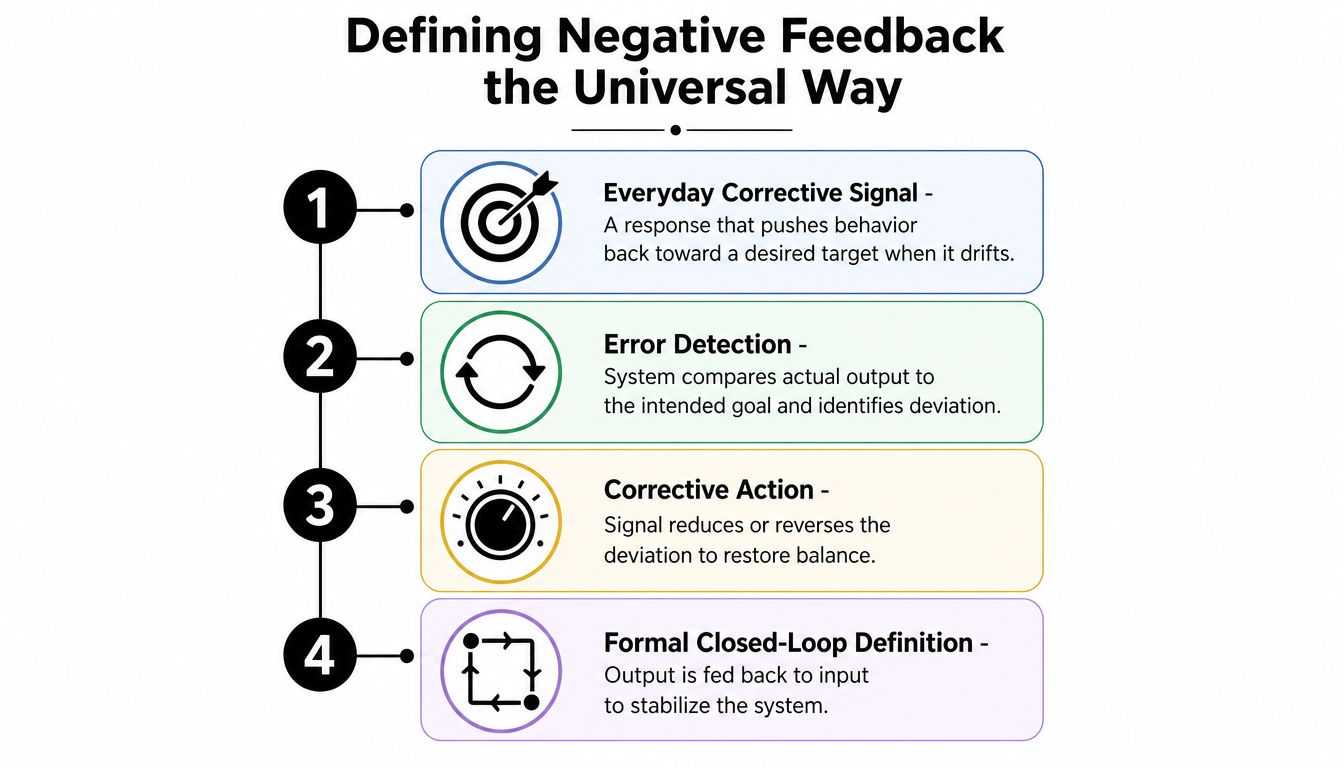
The three ingredients inside the loop
A useful example contains three structural elements:
- A measurable state: The system needs a reading, such as room temperature, body temperature, or content response.
- A reference value: The system needs a desired condition, such as a set point, normal range, or publishing objective.
- A corrective response: The system changes its output to reduce the difference between the measured state and the reference.
The word negative describes direction, not morality or emotion. The response counteracts the deviation that triggered it.
Positive feedback strengthens an initial change. Negative feedback dampens or reverses a disturbance, which helps systems remain stable and less sensitive to noise or component variation, as explained in the IEEE control-systems reference.
Why the vocabulary travels to platforms
A recommendation feed also measures outcomes and adjusts later delivery. The platform has a goal for which content appears relevant to a viewer, observes behavior around a post, and changes how much exposure similar content receives.
The comparison has limits. A social platform contains more variables than a thermostat, and creators cannot see every input or weighting rule. The shared structure still gives the term practical meaning:
A post enters a system, viewers produce measurable reactions, and the system adjusts future distribution.
This model changes the question a creator asks after a weak result. Instead of treating the post as a verdict on personal ability, examine the observable response. Did the opening create friction? Did the post miss its intended audience? Did readers leave before reaching the main point?
Those questions turn negative feedback into a platform signal. The signal does not explain the cause by itself, but it identifies a gap between the draft's publishing objective and the response the system recorded. That gap can guide a specific revision, such as tightening the opening, clarifying the promise, or removing a distracting step.
How Biology and Engineering Build the Same Loop
Negative feedback is a correction loop, not a general idea about criticism. Biology and engineering use different terms, yet both follow the same sequence: detect a change, compare it with a desired condition, then respond in the direction that reduces the gap.
Body temperature regulation makes the pattern concrete. Thermoreceptors detect a temperature shift, the hypothalamus compares the reading with a normal range, and effectors respond. Sweat glands help release heat, muscles shiver to generate it, and blood vessels adjust heat transfer. Each response counteracts the disturbance and moves internal conditions toward balance.
OpenStax's explanation of homeostasis describes this structure through a sensor, a control center, and an effector. Temperature regulation shows why the loop is called negative feedback: the response opposes the original change instead of allowing it to grow.
Blood glucose regulation uses the same logic with different signals and effectors. Pancreatic islet cells release insulin when glucose needs to fall and glucagon when it needs to rise. The body responds according to the direction of the deviation, rather than applying one fixed action to every fluctuation.
The engineering version
A thermostat is the familiar household example, but engineers also apply feedback inside circuits. In an op-amp inverting amplifier, part of the output is fed back so it opposes the input's effect. The arrangement makes the circuit's behavior more predictable and less sensitive to variation among individual components.
The hardware changes. The loop remains recognizable:
| Loop component | Biology example, thermoregulation | Engineering example, thermostat |
|---|---|---|
| Sensor | Thermoreceptors detect temperature changes | Temperature sensor reads the room |
| Reference | Normal internal temperature range | User-selected temperature set point |
| Comparator | Hypothalamus evaluates deviation | Controller compares the reading with the set point |
| Effector | Sweat glands, shivering muscles, and blood vessels respond | Heater or cooling unit activates |
| Corrective direction | Response counteracts the temperature shift | Response reduces the gap from the set point |
| System risk | Delayed or excessive responses can disturb balance | Poor tuning can create overshoot or oscillation |
A correction loop can still misbehave. Delayed sensing, excessive response, or poor measurement can push the system past its target and produce oscillation. Negative feedback supports stability only when sensing, comparison, and response are connected well.
The same limitation applies to recommendation systems. A platform may work from incomplete context, a noisy audience sample, or a behavior that does not fully represent content quality. Its response can still alter distribution. For creators, the useful analogy is therefore diagnostic: inspect which part of the loop may have misread the draft, rather than treating a weak result as a final judgment.
Negative Feedback as a Platform Signal on X and Threads
On X and Threads, negative feedback is best understood as a set of user actions that can tell a recommender system, “This content isn't a good fit for me.” The action may be explicit, such as selecting Not interested, or indirect, such as dismissing a post, muting an account, blocking the author, reporting the content, unfollowing, or scrolling past with little dwell time.
These signals don't all carry the same meaning, and the platforms don't expose a complete public formula for how they combine them. A creator should therefore avoid treating any single action as proof of a hidden penalty. The practical question is whether several behaviors point in the same direction.
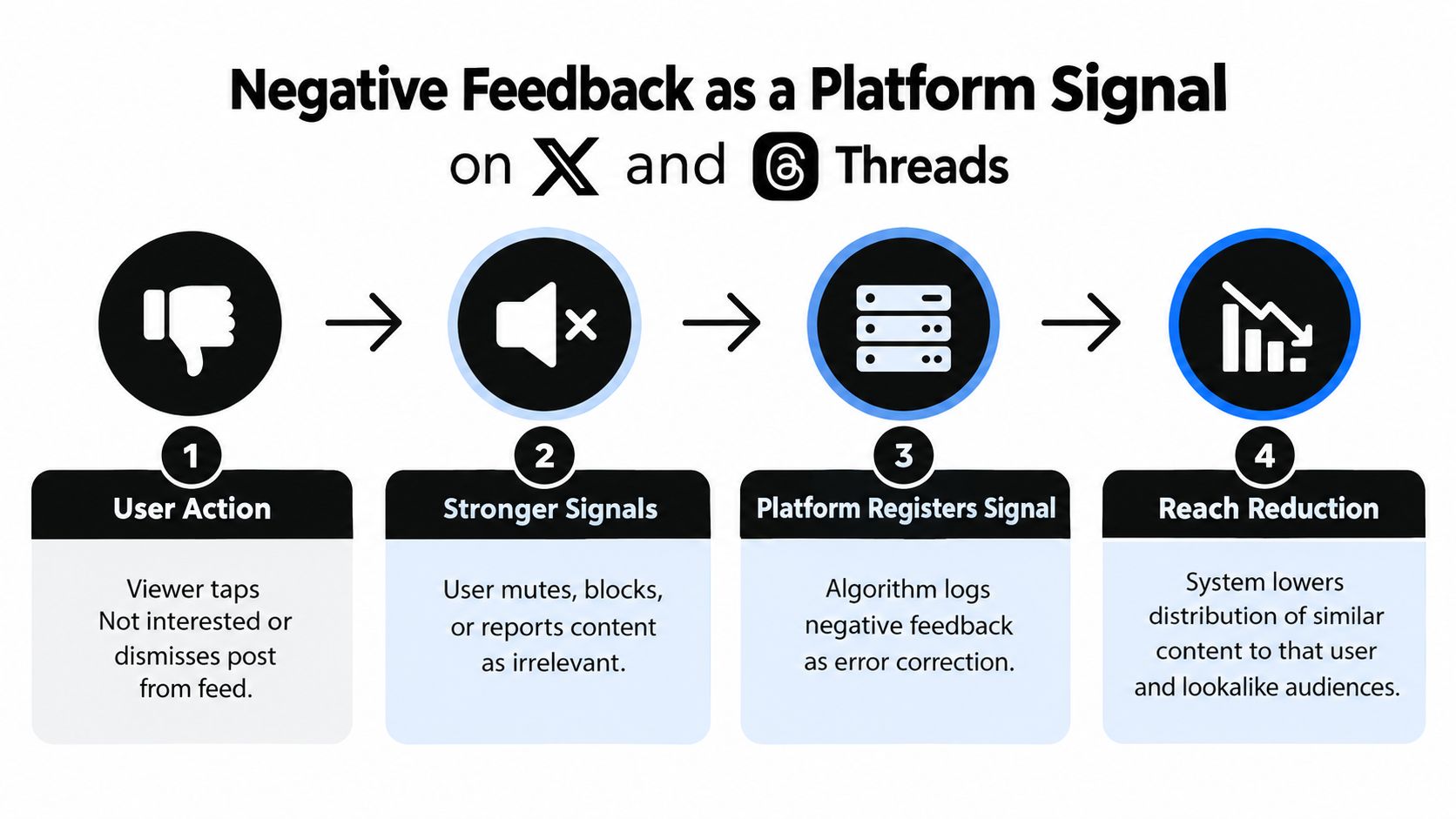
Content-level and account-level readings
A content-level signal concerns one post. The opening may be misleading, the topic may be poorly matched to the audience, or the claim may create enough confusion that readers leave before finding the useful part.
An account-level signal carries a broader history. Repeated dismissals, mutes, blocks, or unfollows may teach the system that a wider set of viewers isn't likely to value the account's recommendations. The exact carryover depends on the platform and its internal ranking process, so creators should describe this as a diagnostic possibility, not a confirmed public rule.
The visible result often looks like throttling rather than punishment. You won't necessarily receive a banner saying that your account has been downgraded. Instead, the impression curve may flatten, non-follower distribution may weaken, or similar posts may receive less initial testing.
The platform loop
The control-theory mapping looks like this:
- Stimulus: You publish a post.
- Measurement: Viewers watch, read, skip, dismiss, mute, block, report, reply, share, or follow.
- Error signal: The platform compares those behaviors with its relevance and quality expectations.
- Correction: The recommender reduces or reallocates distribution for that post, audience segment, or related content.
- New state: Lower distribution creates fewer opportunities for future reactions, until the system tests the content again or receives stronger positive evidence.
The loop can dampen reach without proving that the underlying idea is bad. It may indicate a packaging problem, audience mismatch, unclear context, or a format that asks too much from a viewer too early.
This X draft signal check can help creators inspect a draft before publishing, while keeping the distinction between a public signal model and an official platform score clear.
A short visual summary is useful before moving into diagnosis.
Measurable Signals Creators Should Watch
Creators need a measurement habit, but they also need restraint. The provided evidence doesn't establish universal warning thresholds for X or Threads, and platform dashboards may not expose every negative action. Treat the following as a qualitative checklist, not a fabricated scoring formula.
Start with the post itself. Look for a reach curve that stalls unusually early, weak non-follower exposure, rapid exits, or a sudden concentration of unfollows after one post. A single result can reflect topic variance or timing. Repeated patterns across comparable posts are more useful.
A practical diagnostic table
| Metric or observation | What to watch for | Likely signal |
|---|---|---|
| Not interested actions | A noticeable increase relative to comparable posts | The post may be mismatched to the viewer or framed without enough context |
| Dismissals or rapid scroll-pasts | Early exits concentrated near the opening | The first lines may create confusion, overpromise, or fail to establish relevance |
| Blocks after a post spreads | An unusual cluster following wider exposure | The post may trigger strong audience mismatch, perceived irrelevance, or unwanted repetition |
| Replies compared with impressions | A weaker response than similar posts | The prompt may not invite conversation, or readers may leave before reaching the point |
| Non-follower reach | A sudden decline after a specific content pattern | The system may be reducing exploratory distribution, or the topic may be too narrow |
| Unfollows | A spike connected to one post or recurring format | Existing followers may feel the content no longer matches their expectations |
| Profile visits compared with follows | Visits that rarely become follows | The profile promise, post context, or audience targeting may be unclear |
The most valuable comparison is within your own account. Compare posts with similar topics, formats, and publishing conditions, then inspect what changed in the opening, promise, audience, and call to action.
Don't confuse absence with evidence
No visible criticism doesn't mean no negative feedback occurred. A viewer can leave without commenting, and a platform can register a dismissal without showing it to you. Conversely, a critical reply isn't necessarily harmful. It may generate meaningful discussion and keep readers engaged.
Use this dropped-views diagnostic to investigate reach changes without jumping immediately to the conclusion that an account has been secretly banned. The aim is to separate distribution evidence from assumptions about intent.
A warning sign is a pattern across comparable posts, not one disappointing dashboard.
Drafting and Mitigation Strategies That Reduce the Signal
Mitigation works best when it matches the suspected signal. If people leave because they don't understand the post, changing the ending won't solve the problem. If repeated calls to action create fatigue, adding more context may not be enough.
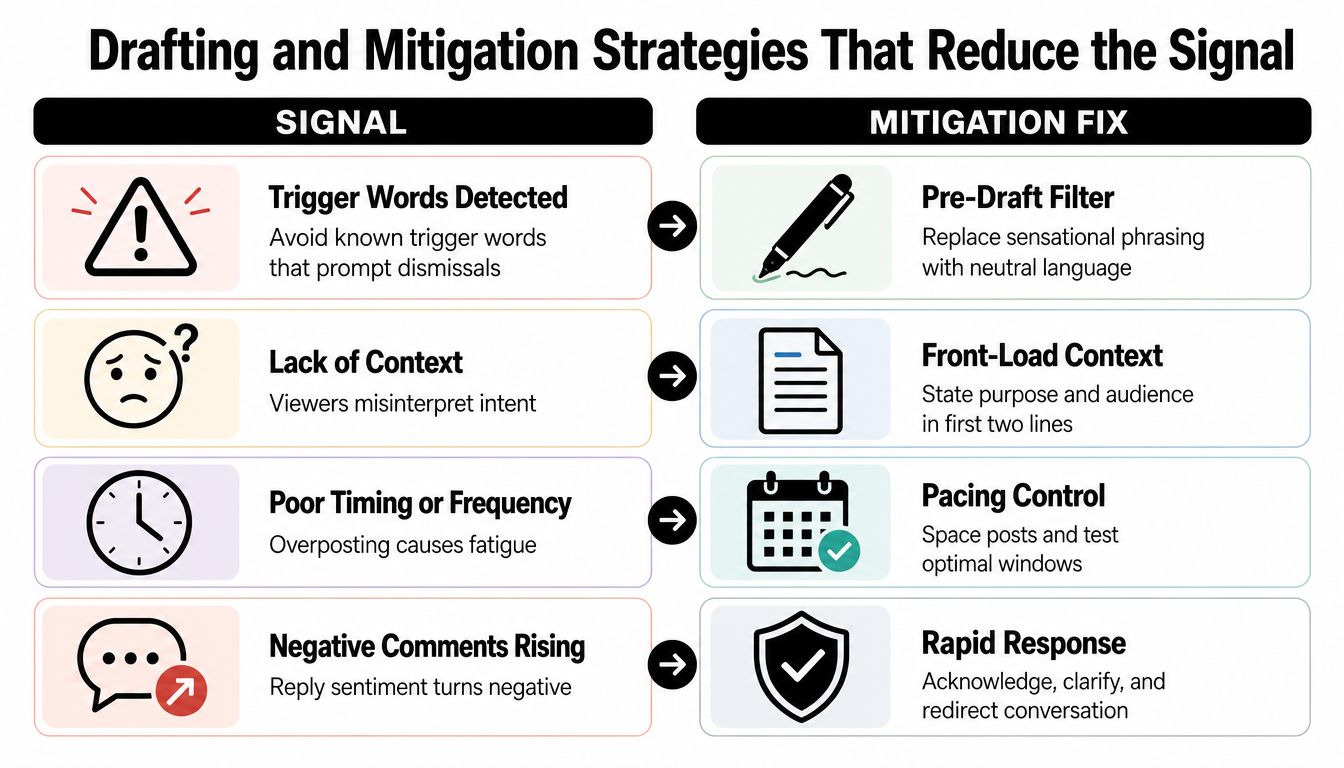
Match the fix to the symptom
| Observed problem | Draft-level response | Why it may help |
|---|---|---|
| Trigger words or sensational framing | Replace bait-like wording with a concrete claim | Readers can evaluate the topic without feeling manipulated |
| Early confusion | State the audience, subject, and practical point in the first two lines | Context arrives before the reader decides whether to continue |
| Mid-thread drop-off | Shorten the thread and give each post one clear job | The reader has fewer opportunities to lose the thread |
| Dismissive reactions to calls to action | Remove stacked requests and use one specific invitation | The post asks for a clearer, lighter response |
| Unwanted exposure | Add an explicit opt-out such as “mute if this isn't useful” | Readers receive a boundary instead of needing to create one themselves |
| Link-related friction | Test placing supporting links after the primary claim | The opening remains focused on the idea rather than the destination |
Before publishing, read the first two lines without the rest of the draft. Ask what a new viewer would think the post is about, who it serves, and what action it seems to demand. Then run a five-second friend test. If a friend can't explain the post's subject and promise after a quick glance, unfamiliar viewers may also leave before the value appears.
Don't change everything at once. Choose two fixes that correspond to the strongest observed pattern, record the draft versions, and compare similar posts later. That keeps mitigation from becoming a vague exercise in polishing.
Three Experiments to Validate the Impact on Your Own Account
Negative feedback isn't uniformly harmful, and not every corrective signal means you should retreat from a challenging topic. The 2024 preregistered set of five studies found that negative feedback made the goal to feel better more salient, while the goal to perform better shaped regulation strategy choice, with reappraisal preferred when performance goals were activated, as reported in the PubMed record. The practical lesson is to test context, not assume that all criticism has one effect.
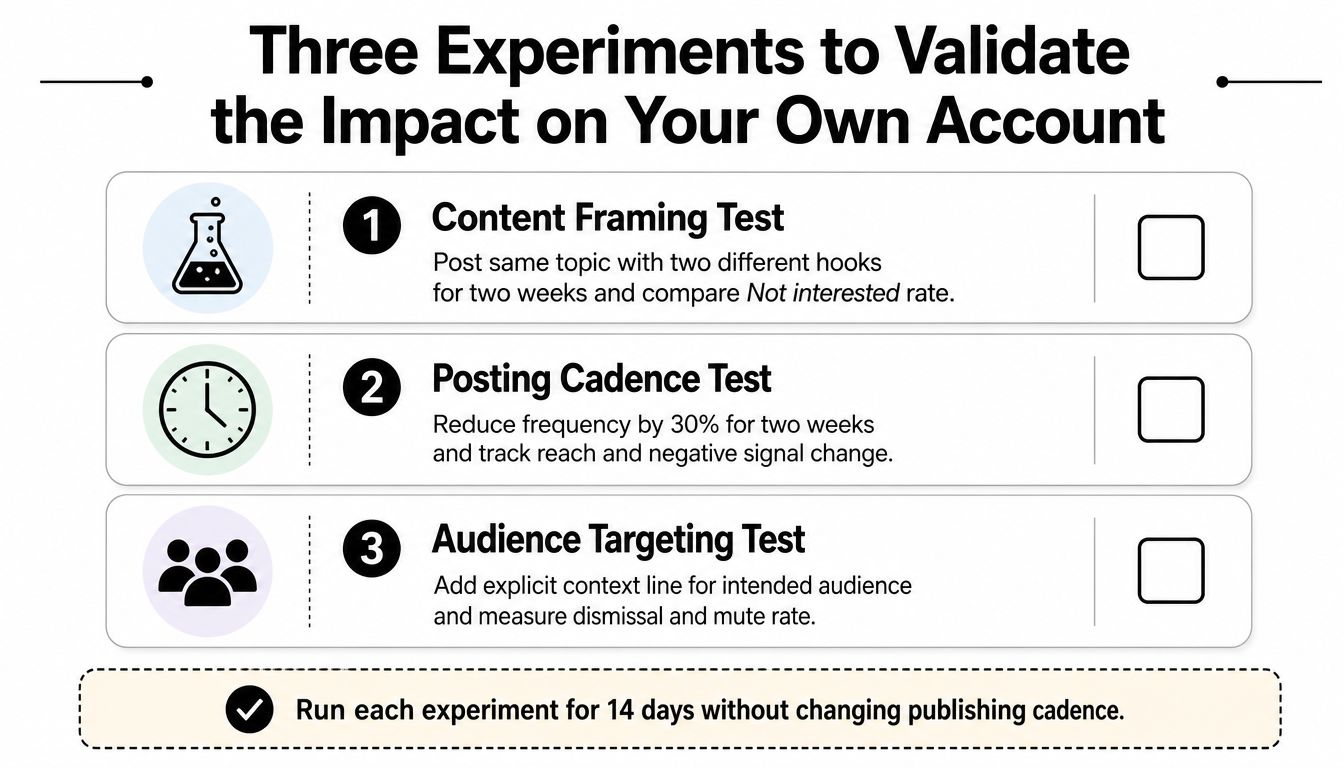
Experiment one, rewrite the hook
For two weeks, publish matched posts about closely related topics while varying the opening sentence. Keep the main claim, audience, and format as similar as practical. Record impressions, early exits where available, dismissals, blocks, replies, and profile actions.
Your baseline is the recent performance of comparable posts. A useful success criterion is a consistent reduction in negative actions without a corresponding loss of meaningful replies or profile interest. Attribute cautiously. If the topics differ greatly, you can't know whether the hook or the subject caused the change.
Experiment two, alter reply density
Keep the post format and opening stable, then compare a single anchor reply with a small set of conversational prompts. Measure whether additional prompts create useful discussion or encourage dismissals and muted interactions.
The baseline is the version with your normal reply behavior. Success means the response pattern improves conversation quality without increasing negative signals. Don't interpret more replies alone as success. The loop cares about the mixture of reactions, not just visible activity.
Experiment three, test format
Alternate short standalone posts with longer threads while keeping the subject and audience promise close. Track where distribution changes, whether readers remain engaged through the format, and whether profile visits convert differently.
For a deeper view of reach changes during the test, use this dropped-views learning guide. Keep a simple experiment log, change one main variable at a time, and compare groups rather than isolated winners.
A Shared Mental Model for the Next Draft
A draft is a stimulus entering a closed loop. The audience supplies sensor readings through attention, dismissal, replies, mutes, blocks, reports, unfollows, shares, and follows. The platform acts as the controller and effector by changing who receives similar content next.
That model gives you a pre-publish question more useful than “Will people like this?” Ask: What reaction could tell the system this post is irrelevant, confusing, repetitive, or poorly matched to the viewer? Then revise the opening, context, promise, format, or call to action to reduce avoidable friction.
Human feedback also depends on context. The evidence summarized in a 2025 study of negative social feedback found stronger emotional reactions and deeper negative memories when feedback came from acquaintances rather than strangers. A separate review identified the provider, delivery style, and receiver characteristics as important moderators, which explains why the same critique can motivate one person and discourage another.
Platforms will continue refining how they interpret low-quality engagement cues, and creators may gain access to additional indicators over time. Don't treat today's visible metrics as the entire loop. Carry the mental model into every draft, measure the response, and let repeated evidence guide the next adjustment.
Yubook gives creators and teams a browser-based draft studio, explainable signal analysis, forecast ranges, cross-platform publishing to X and Threads, and prediction-versus-actual performance replay. Visit Yubook to test your next draft against observable platform signals and turn negative feedback into a focused publishing experiment.